|
 |
 |
 |
 |
 |
 |
 |
 |

 |
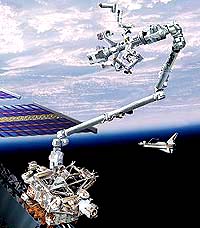
Astronauts Practise to use the Canadarm2 on the International Space Station
Saint-Hubert - May 26, 2003 Imagine playing the most complicated video game ever created. Then imagine being asked to play it at peak efficiency without practicing for several months. Imagine also that the cost of your error could be over $50,000,000. In a way that was exactly what was originally asked of astronauts operating Canadarm2 aboard the International Space Station (ISS). Like that imaginary video game, operating a 35-foot crane-like object through a TV monitor in space requires exceptional manual and visual dexterity, and while astronauts undergo rigorous training before venturing into space, they've been unable to practise these particular skills after arriving on the Space Station. Since the astronauts on ISS will stay in orbit for three or more months there was an urgent need to develop an on-orbit trainer for astronauts. Unfortunately, the technology required to produce a portable, self-sustained training unit -- as well as the computing power to provide the simulation accuracy required -- simply wasn't available. Until now, that is. A team of Russian and Canadian space researchers and engineers has successfully pushed back the technology envelope, developing an on-site trainer for the International Space Station. The System for Maintaining and Monitoring Performance (SMP) On-Orbit MSS Astronaut Training System consists of a small laptop computer and two hand-controls. Training and analysis modules incorporated in the system allow astronauts to practise, among other things, capturing free-flying objects such as small satellites, which is the most difficult task that a Canadarm2 operator may be required to perform. Canada played a pivotal role in two significant breakthroughs that helped make the on-site trainer possible. The first is a highly efficient simulation software tool -- SYMOFROS, developed by the Canadian Space Agency (CSA). The other is a smart electronics card, developed by a small Canadian company called Xiphos Technologies in collaboration with the CSA. The card easily interfaces hand-controllers to portable computers. When SYMOFROS and the smart card were combined with Russian expertise in on-board system integration, the final hurdle to the development of an on-orbit trainer was overcome. The SMP On-Orbit Mobile Servicing System Astronaut Training System was launched on-board the Soyuz Progress Transport on February 2, 2003. Community Email This Article Comment On This Article Related Links Canadian Space Agency SpaceDaily Search SpaceDaily Subscribe To SpaceDaily Express Space Station News at Space-Travel.Com
 NASA Had No Choice But To Buy Soyuz Flights
 Washington DC (SPX) Jan 09, 2006
NASA's announcement last week that it will pay Roskosmos $43.6 million for a round-trip ride to the International Space Station this spring, and an equivalent figure for an as-yet-undetermined number of future flights to the station until 2012, represents the agency's acknowledgment that it had no alternative. |
|
|

| The content herein, unless otherwise known to be public domain, are Copyright 1995-2006 - SpaceDaily.AFP and UPI Wire Stories are copyright Agence France-Presse and United Press International. ESA PortalReports are copyright European Space Agency. All NASA sourced material is public domain. Additionalcopyrights may apply in whole or part to other bona fide parties. Advertising does not imply endorsement,agreement or approval of any opinions, statements or information provided by SpaceDaily on any Web page published or hosted by SpaceDaily. Privacy Statement |