|
 |
 |
 |
 |
 |
 |
 |
 |

 |
Asteroids Caused The Early Inner Solar System Cataclysm
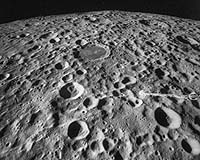
Tucson (SPX) Sep 16, 2005 University of Arizona and Japanese scientists are convinced that evidence at last settles decades-long arguments about what objects bombarded the early inner solar system in a cataclysm 3.9 billion years ago. Ancient main belt asteroids identical in size to present-day asteroids in the Mars-Jupiter belt - not comets - hammered the inner rocky planets in a unique catastrophe that lasted for a blink of geologic time, anywhere from 20 million to 150 million years, they report in the Sept. 16 issue of Science. However, the objects that have been battering our inner solar system after the so-called Late Heavy Bombardment ended are a distinctly different population, UA Professor Emeritus Robert Strom and colleagues report in the article, "The Origin of Planetary Impactors in the Inner Solar System." After the Late Heavy Bombardment or Lunar Cataclysm period ended, mostly near-Earth asteroids (NEAs) have peppered the terrestrial region. Strom has been studying the size and distribution of craters across solar system surfaces for the past 35 years. He has long suspected that two different projectile populations have been responsible for cratering inner solar system surfaces. But there's been too little data to prove it. Until now. Now asteroid surveys conducted by UA's Spacewatch, the Sloan Digital Sky Survey, Japan's Subaru telescope and the like have amassed fairly complete data on asteroids down to those with diameters of less than a kilometer. Suddenly it has become possible to compare the sizes of asteroids with the sizes of projectiles that blasted craters into surfaces from Mars inward to Mercury. "When we derived the projectile sizes from the cratering record using scaling laws, the ancient and more recent projectile sizes matched the ancient and younger asteroid populations smack on," Strom said. "It's an astonishing fit." "One thing this says is that the present-day size-distribution of asteroids in the asteroid belt was established at least as far back as 4 billion years ago," UA planetary scientist Renu Malhotra, a co-author of the Science paper, said. "Another thing it says is that the mechanism that caused the Late Heavy Bombardment was a gravitational event that swept objects out of the asteroid belt regardless of size." Malhotra discovered in previous research what this mechanism must have been. Near the end of their formation, Jupiter and the other outer gas giant planets swept up planetary debris farther out in the solar system, the Kuiper Belt region. In clearing up dust and pieces leftover from outer solar system planet formation, Jupiter, especially, lost orbital energy and moved inward closer to the sun. That migration greatly enhanced Jupiter's gravitational influence on the asteroid belt, flinging asteroids irrespective of size toward the inner solar system. Evidence that main belt asteroids pummeled the early inner solar system confirms a previously published cosmochemical analysis by UA planetary scientist David A. Kring and colleagues. "The size distribution of impact craters in the ancient highlands of the moon and Mars is a completely independent test of the inner solar system cataclysm and confirms our cosmochemical evidence of an asteroid source," Kring, a co-author of the Science paper, said. Kring was part of a team that earlier used an argon-argon dating technique in analyzing impact melt ages of lunar meteorites - rocks ejected at random from the moon's surface and that landed on Earth after a million or so years in space. They found from the ages of the "clasts," or melted rock fragments, in the breccia meteorites that all of the moon was bombarded 3.9 billion years ago, a true global lunar cataclysm. The Apollo lunar sample analysis said that asteroids account for at least 80 percent of lunar impacts. Comets have played a relatively minor role in inner solar system impacts, Strom, Malhotra and Kring also conclude from their work. Contrary to popular belief, probably no more than 10 percent of Earth's water has come from comets, Strom said. After the Late Heavy Bombardment, terrestrial surfaces were so completely altered that no surface older than 3.9 billion years can be dated using the cratering record. Older rocks and minerals are found on the moon and Earth, but they are fragments of older surfaces that were broken up by impacts, the researchers said. Strom said that if Earth had oceans between 4.4 billion and 4 billion years ago, as other geological evidence suggests, those oceans must have been vaporized by the asteroid impacts during the cataclysm. Kring also has developed a hypothesis that suggests that the impact events during Late Heavy Bombardment generated vast subsurface hydrothermal systems that were critical to the early development of life. He estimated that the inner solar system cataclysm produced more than 20,000 craters between 10 kilometers to 1,000 kilometers in diameter on Earth. Inner solar system cratering dynamics changed dramatically after the Late Heavy Bombardment. From then on, the impact cratering record reflects that most objects hitting inner solar system surfaces have been near-Earth asteroids, smaller asteroids from the main belt that are nudged into terrestrial-crossing orbits by a size-selective phenomenon called the Yarkovsky Effect. The effect has to do with the way asteroids unevenly absorb and re-radiate the sun's energy. Over tens of millions of years, the effect is large enough to push asteroids smaller than 20 kilometers across into the jovian resonances, or gaps, that deliver them to terrestrial-crossing orbits. The smaller the asteroid, the more it is influenced by the Yarkovsky Effect. Planetary geologists have tried counting craters and their size distribution to get absolute ages for surfaces on the planets and moons. "But until we knew the origin of the projectiles, there has been so much uncertainty that I thought it could lead to enormous error," Strom said. "And now I know I'm right. For example, people have based the geologic history of Mars on the heavy bombardment cratering record, and it's wrong because they're using only one cratering curve, not two." Attempts to date outer solar system bodies using the inner solar system cratering record is completely wrong, Strom said. But it should be possible to more accurately date inner solar system surfaces once researchers determine the cratering rate from the near-Earth asteroid bombardment, he added. The authors of the Science paper are Strom, Malhotra and Kring from the University of Arizona Lunar and Planetary Laboratory, and Takashi Ito and Fumi Yoshida of National Astronomical Observatory, Tokyo, Japan. Community Email This Article Comment On This Article Related Links Lunar and Planetary Laboratory SpaceDaily Search SpaceDaily Subscribe To SpaceDaily Express Asteroid and Comet Mission News, Science and Technology
 NASA'S Spitzer Finds Possible Comet Dust Around Dead Star
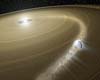 Pasadena CA (SPX) Jan 12, 2006
NASA's Spitzer Space Telescope has spotted what may be comet dust sprinkled around the white dwarf star G29-38, which died approximately 500 million years ago. |
|
|

| The content herein, unless otherwise known to be public domain, are Copyright 1995-2006 - SpaceDaily.AFP and UPI Wire Stories are copyright Agence France-Presse and United Press International. ESA PortalReports are copyright European Space Agency. All NASA sourced material is public domain. Additionalcopyrights may apply in whole or part to other bona fide parties. Advertising does not imply endorsement,agreement or approval of any opinions, statements or information provided by SpaceDaily on any Web page published or hosted by SpaceDaily. Privacy Statement |