|
 |
 |
 |
 |
 |
 |
 |
 |

 |
Asteroid "Itokawa", Target of "HAYABUSA", Comes in Sight
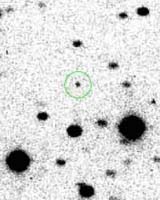
Tokyo - Jan 07, 2004 The asteroid "Itokawa", target of the asteroid explorer "HAYABUSA" launched in May 2003, comes in sight in over two years since August 2001. Until now, we have been unable to observe the asteroid because it has been too dark, under twentieth-magnitude, and located not so far from the Sun when looking it from earth. From December 1 to 4, 2003, four members, Abe, Nishihara, Kitazato, and Sarugaku, observed the asteroid using the 105 cm Schmidt telescope at the Kiso Observatory, University of Tokyo. The photo was taken with 900 sec exposure from 5:18:09 p.m. (UT) on December 3, 2003. The point in circle is Itokawa. The brightness at that time was about twentieth-magnitude. The distance between Itokawa and earth was about 0.77AU (about 115 million km, 1AU is about 150 million km). The distance between Itokawa and the Sun was about 1.52AU (228 million km). Width of the photo is 8 arc minutes. Upper is north and right is east (using 2KCCD camera with R band filter and magnitude is R band). Itokawa will gradually close to earth and, on June 26, 2004, it will be closest to earth with distance of 0.013AU (about 1.95 million km). But, unfortunately, it will be then located at the south hemisphere. It is estimated that the asteroid will become about twelfth magnitude (about 1,500 times brighter compared to the present). The ion engines of "HAYABUSA" are now operating in perfect condition, and the explorer is flying smoothly. Community Email This Article Comment On This Article Related Links Japan Aerospace Exploration Agency SpaceDaily Search SpaceDaily Subscribe To SpaceDaily Express Asteroid and Comet Mission News, Science and Technology
 NASA'S Spitzer Finds Possible Comet Dust Around Dead Star
 Pasadena CA (SPX) Jan 12, 2006
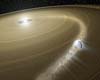
NASA's Spitzer Space Telescope has spotted what may be comet dust sprinkled around the white dwarf star G29-38, which died approximately 500 million years ago. |
|
|

| The content herein, unless otherwise known to be public domain, are Copyright 1995-2006 - SpaceDaily.AFP and UPI Wire Stories are copyright Agence France-Presse and United Press International. ESA PortalReports are copyright European Space Agency. All NASA sourced material is public domain. Additionalcopyrights may apply in whole or part to other bona fide parties. Advertising does not imply endorsement,agreement or approval of any opinions, statements or information provided by SpaceDaily on any Web page published or hosted by SpaceDaily. Privacy Statement |