|
 |
 |
 |
 |
 |
 |
 |
 |

 |
Assessing The Iraqi Militias
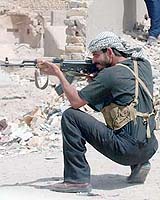
UPI Outside View Commentator Washington (UPI) May 22, 2006 If one looks at today's militias in Iraq, the forces of the Shiite Supreme Council of Islamic Revolution in Iraq, or SCIRI, are often new or lower grade older personnel which generally are much better suited to sectarian and ethnic struggles than the SCIRI forces trained by Iran through 2003 as regular forces. They are often more loyal to local leaders than any given national leader, and it is often difficult to distinguish between true militia, associate, and someone in the security services that may support the SCIRI militia. Some are getting training in Iran, but it seems more paramilitary than military. Moqtada al-Sadr's "Mahdi Army" "militia" has little real training and a comparatively loose organization and hierarchy. In some areas, like Basra, it may be more a matter of loose affiliation than real control. In others, it is often nothing more than local volunteers, many who only serve on a part-time basis. The cadres with real discipline and training seem to be small, although the "Mahdi Army" is still a very real force and the fact they can draw on so many local supporters and volunteers in areas with a high percentage of Sadr loyalists can make them even more dangerous. The 10,000 figure quoted for this force another WAG, but it may understate popular support in pro-Sadr areas. They can easily assemble instant mobs of young men. Other militias are smaller, like Dawa, and are often more leadership security forces or local security forces than real militias. They too have elements more loyal to a given local, tribal, or religious leader than a national leadership. Only the Kurdish forces seem to have a clear hierarchical structure tied to one leader, but they are still split between Talibani and Barzani, and have tribal elements. No one, however, can really tell the difference between such forces and the police in a number of areas. The police mix the "trained and equipped" police that are in the Multinational Force, or MNF-I, totals -- a mix of local police and security forces -- with various other protection and guard forces. They too can include criminals and gang members, particularly since criminal prosecution has often been negligible and record checks of behavior since 2003 can be meaningless. The lines between gang member, criminal, sectarian or ethnic force, insurgent, and security force are often tenuous, and the difference between criminal and corrupt is even harder to determine. The worst examples of this "blurring of all the lines" are the exception, and not the rule. There are many parts of Iraq with reasonable security at the local level. However, the quality of Iraqi forces in those areas with high levels of sectarian and ethnic tension has been hurt. The mix of Iraqi forces, militias, local security, insurgents, and criminals in these high-tension areas could also lead to the same extreme violence and criminal behavior in a major civil war that occurred in the Balkans and Africa when factional forces had strong criminal elements. On the other hand, if the new Iraqi government takes hold, many of these elements might well turn back towards a far more normal way of life, the moment that there are real jobs and careers and most of the various factions see there is a better future in living together than fighting. Solving the problem doesn't mean pushing low quality and factional militias into the regular Iraqi forces. It means creating a national government and a national political compromise that removes much of the cause for sectarian and ethnic strife. If Iraq's political leaders can do this, many of these problems can gradually be solved. If they fail, spotlighting the militia simply ignores the real nature of the problem and the scale of its complexity. (Anthony H. Cordesman holds the Arleigh A. Burke chair of Strategy at the Center for Strategic and International Studies in Washington.) (United Press International's "Outside View" commentaries are written by outside contributors who specialize in a variety of important issues. The views expressed do not necessarily reflect those of United Press International. In the interests of creating an open forum, original submissions are invited.)
Source: United Press International Community Email This Article Comment On This Article Related Links Subscribe to SinoDaily Express - your China News Source Iraq: The first technology war of the 21st century
 Iraqs Militia Problem
 Washington (UPI) May 19, 2006
During April, the problem of Iraq's ethnic and sectarian militias has gained more and more attention. Some articles have claimed they have become as serious a problem as the insurgency, or an even more serious prelude to civil war. |
|
|

| The content herein, unless otherwise known to be public domain, are Copyright 1995-2006 - SpaceDaily.AFP and UPI Wire Stories are copyright Agence France-Presse and United Press International. ESA PortalReports are copyright European Space Agency. All NASA sourced material is public domain. Additionalcopyrights may apply in whole or part to other bona fide parties. Advertising does not imply endorsement,agreement or approval of any opinions, statements or information provided by SpaceDaily on any Web page published or hosted by SpaceDaily. Privacy Statement |