|
 |
 |
 |
 |
 |
 |
 |
 |

 |
Asia's space race heats up as China readies lunar probe
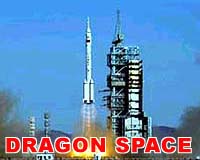
Beijing (AFP) Oct 24, 2007 Asia's space race heated up on Wednesday as China prepared for a prime-time launch of its first lunar orbiter, an event being seen in the world's most populous nation as a sign of its global rise. The launch of Chang'e I, which will explore and map the moon's surface, comes after Japan last month launched its first lunar probe and ahead of a planned similar mission by India next year. China's year-long expedition, costing 1.4 billion yuan (184 million dollars), kicks off a programme that aims to land an unmanned rover on the moon's surface by 2012 and then put a man on the moon by about 2020. China's government-controlled media on Wednesday gave widespread coverage to the planned launch, which was scheduled for 6.00 pm (1000 GMT) and set to be broadcast on national television. Front-page newspaper reports emphasised the lunar probe would be the third major milestone in China's space ambitions, after sending men into orbit in 2003 and 2005. In the months leading up to the launch, one of the chief scientists in China's moon programme, Ouyang Ziyuan, also pointed to the broader message a successful mission would send to the Chinese people and the world. "As lunar exploration embodies our overall national strength, it is very significant for raising our international prestige and our national unity," Ouyang told the ruling Communist Party's mouthpiece, the People's Daily. A front-page report in the English-language China Daily said 1,000 Chinese journalists had converged on Xichang Satellite Launching Centre in southwestern China's Sichuan province to cover the event. On September 14, Japan launched its first lunar orbiter as a key step in putting a man on the moon by 2020. Although the timeframes for China and Japan to eventually put someone on the moon are roughly similar, some Chinese officials were trying to play down the rivalry. "Japan began its lunar exploration research much earlier than we did, so we have always stressed that with the launch of Chang'e, we don't want to be talking about who is first," top mission official Zhang Jianqi said. China's project engineers expressed concern over whether newly developed technology would perform correctly during the flight of the Chang'e, which is named after a Chinese fairy. "We are all preparing for possible failure because if one little thing goes wrong, the whole mission could fail," Zhang told the Beijing Times in an interview. "If everything proceeds smoothly we will be able to announce (the success of the mission) around November 7," Zhang said. The orbiter is expected to transmit its first pictures of the moon back to earth by the end of November. According to Rene Oosterlinck, a European Space Agency spokesman, the ongoing race to the moon, which also includes a renewed American effort, is largely aimed at setting up permanent lunar bases as a first step to eventual exploration of Mars. "The Chinese satellite will mainly be taking three dimensional pictures of the moon surface to see where it will be possible to land in the future to set up a lunar base," Oosterlinck told AFP. China successfully launched astronaut Yang Liwei into orbit in 2003, making it the third country after the former Soviet Union and the United States to put a man in space. Its third manned space flight is scheduled for late 2008 on a mission that will include three astronauts and China's first ever space walk. Community Email This Article Comment On This Article Related Links The Chinese Space Program - News, Policy and Technology China News from SinoDaily.com
 China plans to launch first moon orbiter on Wednesday
 Beijing (AFP) Oct 22, 2007
China, which plans one day to send a human to the moon, said it expected to launch its first lunar orbiter on Wednesday, state media reported, quoting the country's space agency. |
|
|

| The content herein, unless otherwise known to be public domain, are Copyright 1995-2007 - SpaceDaily.AFP and UPI Wire Stories are copyright Agence France-Presse and United Press International. ESA Portal Reports are copyright European Space Agency. All NASA sourced material is public domain. Additional copyrights may apply in whole or part to other bona fide parties. Advertising does not imply endorsement,agreement or approval of any opinions, statements or information provided by SpaceDaily on any Web page published or hosted by SpaceDaily. Privacy Statement |