|
 |
 |
 |
 |
 |
 |
 |
 |

 |
Asia-Pacific Faces Global Warming Disaster
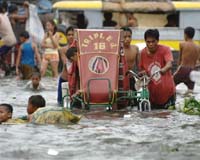
Sydney (AFP) Oct 10, 2006 Millions of people in the Asia-Pacific region could be forced from their homes and suffer increasing disease, cyclones and floods caused by global warming, scientists warned Monday. Climate change will seriously threaten regional human security and national economies this century, according to a report by the Australian government's Commonwealth Scientific and Research Organisation (CSIRO). "Chronic food and water insecurity and epidemic disease may impede economic development in some nations," the report says. "Degraded landscapes and inundation of populated areas by rising seas may ultimately displace millions of individuals, forcing intra- and inter-state migration." The report, commissioned by a coalition of environmental, aid, church and development groups, analyses predictions of temperature increases of up to two degrees Celsius by 2030 and up to seven degrees by 2070. Scientists blame global warming on greenhouse gases such as carbon dioxide, produced mainly by the burning of fossil fuels including coal and oil, for causing rising temperatures worldwide. "Rapid growth in large regional economies such as China and India has elevated human prosperity," the report says. "However, unless ultimately decoupled from fossil-fuel use, such growth also threatens to exacerbate the climate challenge." The CSIRO says that remaining below the generally accepted threshold for "dangerous" climate change of about two degrees Celsius would require global greenhouse gas emissions to be reduced by 30-55 percent below 1990 levels. "If you don't, if you did nothing, you're likely to blow right past it," Benjamin Preston, key author of the report, told AFP. Temperatures are likely to rise more quickly in the arid areas of northern Pakistan and India and western China, the report says. But the region will also be affected by a rise in the global sea level of up to 16 centimetres (six inches) by 2030 and by up to 50 centimetres in 2070, along with regional variables. Preston said two studies contained in the report estimate that a sea-level rise of a metre (39 inches) would displace between 75 million and 150 million people in the Asia-Pacific region. Most at risk are the low-lying river deltas of Bangladesh, India, Vietnam and China, as well as the small Pacific island states. Changing patterns of temperature and rainfall would also cause a shift in the distribution of dengue and malaria-carrying mosquitoes, likely exposing millions more people to such diseases by the end of the century. "Higher temperatures may reduce the risk of cold-weather mortality, but increase heat-related mortality, while increased flooding and intensification of tropical cyclones would increase climate-related injuries and deaths," the report says. The aid groups that commissioned the report said it was a wake-up call for Australia, one of the world's worst polluters on a per-capita basis. "Climate change will fundamentally change the way we aid the world's poor," said World Vision Australia chief executive Tim Costello. "It will undermine the value and impact of current aid spending and will lead to far greater calls for assistance from those hurt most." Environmental and rights activists also called on the government to prepare to accept environmental refugees fleeing small Pacific island states hit by rising sea levels.
Source: Agence France-Presse Community Email This Article Comment On This Article Related Links Learn about Climate Science at TerraDaily.com Climate Science News - Modeling, Mitigation Adaptation
 Arctic Sea Ice Declines Again In 2006
 Boulder CO (SPX) Oct 05, 2006
While cool August temperatures prevented sea ice in the Arctic from reaching its lowest summer extent on record, 2006 continued a pattern of sharp annual decreases due to rising temperatures probably caused by greenhouse warming, according to University of Colorado at Boulder researchers. |
|
|

| The content herein, unless otherwise known to be public domain, are Copyright 1995-2006 - SpaceDaily.AFP and UPI Wire Stories are copyright Agence France-Presse and United Press International. ESA PortalReports are copyright European Space Agency. All NASA sourced material is public domain. Additionalcopyrights may apply in whole or part to other bona fide parties. Advertising does not imply endorsement,agreement or approval of any opinions, statements or information provided by SpaceDaily on any Web page published or hosted by SpaceDaily. Privacy Statement |