|
 |
 |
 |
 |
 |
 |
 |
 |

 |
As Aral Dries Up, Soviet Union's Biological Weapons Secrets Surface
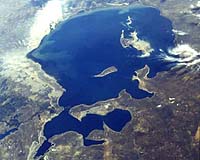
Aralsk, Kazakhstan (AFP) Aug 10, 2005 As the Aral Sea in southwestern Kazakhstan continues to shrink, the deadly legacy of the Soviet Union's biological weapons programme is threatening to spread illness in this arid region. For nearly 60 years, Soviet scientists used the Aral Sea island of Vozrozhdenie (Rebirth) to test bacteriological weapons - including anthrax and the plague - in top-secret laboratories. The experiments ended in 1991 and much of the infrastructure on the island, now shared between the Central Asian states of Uzbekistan and Kazakhstan, has been destroyed but scientists say the diseases may have survived in animals. The waters of the Aral Sea are receding and Vozrozhdenie is de facto no longer an island and is linked to the mainland by a swamp. "The day the passage to the island is completely dry, animals could leave the island and bring their diseases with them," warned Askar Khussainov, head of an Aralsk inhabitants' support group. The threat of the Soviet legacy is still real. In 2002, the US army got permission from Uzbekistan to unearth and destroy stocks of anthrax buried on Vozrozhdenie for fear they could be stolen and used by militants. The Aral Sea began receding forty years ago as irrigation canals from the Amu-Darya river were built to develop cotton plantations in the Uzbek desert. Now, inhabitants of the former fishing port of Aralsk, 70 kilometres away from the sea shore, are likely to suffer from digestive and kidney diseases because the shrinking water supply is four times more salty than norms set by the World Health Organisation (WHO). Adding to the problem, the wind sweeping through this bleak land carries with it chemicals used in cotton farming from the exposed sea beds into residential areas. When rockets are launched from Russia's space base at Baikonur in Kazakhstan, some 200 kilometres (124 miles) south of Aralsk, the concentration of chemicals in the wind is even higher, said Sharapat Medetov, deputy head doctor at Aralsk hospital. "On the day they launch a rocket, sand storms and therefore chemicals rise up. When this happens, you can't even open your eyes," Medetov said. Eye diseases, neurological disorders and skin illnesses are becoming more widespread in Aralsk, even though no scientific study has ever proved a link to rocket launches. "People permanently breathe in salt and chemicals," said Medetov. "Almost everyone here is anaemic. Women's milk is polluted by nitrates which make babies already weak from anaemia even more sick." Community Email This Article Comment On This Article Related Links Our Polluted World and Cleaning It Up
 Toxin Level In Chinese River Still Unsafe
 Beijing (AFP) Jan 11, 2006
Levels of a cancer-causing chemical found in a Chinese river are still above safety standards after a spill last week, despite earlier official reassurances, state media reported Wednesday. |
|
|

| The content herein, unless otherwise known to be public domain, are Copyright 1995-2006 - SpaceDaily.AFP and UPI Wire Stories are copyright Agence France-Presse and United Press International. ESA PortalReports are copyright European Space Agency. All NASA sourced material is public domain. Additionalcopyrights may apply in whole or part to other bona fide parties. Advertising does not imply endorsement,agreement or approval of any opinions, statements or information provided by SpaceDaily on any Web page published or hosted by SpaceDaily. Privacy Statement |