|
 |
 |
 |
 |
 |
 |
 |
 |

 |
Arizonian Optical Engineers Play Key Role In Gravity Probe B
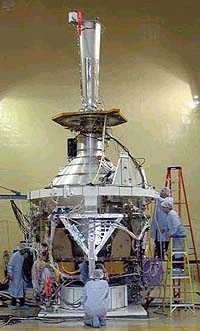
Tucson - Apr 15, 2004 University of Arizona optical scientists have played important roles in the Gravity Probe B experiment, which will test key ideas in Albert Einstein's theories of space and time. The Stanford University experiment, first proposed 40 years ago, will finally start Monday (April 19) when NASA launches the $700 million science mission. It will test two predictions in Einstein's General Theory of Relativity -- that massive bodies such as Earth warp space and time, and that such bodies drag space-time with them as they rotate. If Einstein was right, physicists and cosmologists will heave huge sighs of relief. If he was wrong, they'll have to question their core beliefs about the expanding universe. The test uses extremely uniform spinning quartz balls that are the heart of four liquid-helium-cooled gyroscopes. Scientists will point the satellite's small telescope at a distant "guide star" and align these spinning gyros. And then, for the next 18 months as the satellite orbits 400 miles above Earth, they'll look, very precisely, for tiny changes in the gyros' spin. Stanford scientists asked UA optical sciences Professor Emeritus Stephen Jacobs to test several candidate samples of fused quartz materials from which to fabricate the perfectly spherical quartz balls, or "rotors." "They wanted to be sure they were using the best quartz samples they could get their hands on," Jacobs said. Researchers in his Dimensional Stability Lab used advanced laser technologies to test thermal expansion and other properties of the quartz. "Ours was a small but important role," Jacobs said. Stanford also awarded the Optical Sciences Optics Laboratory another important piece of the experiment -- the job of polishing the 75-pound quartz block that holds the four gyroscopes. Two previous polishing attempts at other facilities failed. Optics Lab manager Martin J. Valente and his team successfully polished the 22-inch long, 7.25-inch-diameter quartz block that holds the gyros. They also produced a second, identical block in 1998 for flight backup. "We're very proud of what we were able to do," Valente said. "This was an extremely challenging project -- one that had not been done before." UA researchers spent 14 months grinding and polishing the blocks to exacting specifications. The block face on which the telescope sits is polished to within 2.5 millionths-of-an-inch, peak to valley. The other block faces were polished to a smoothness of 7 millionths-of-an-inch. But the greatest challenge came in holding very tight angular tolerances between the block faces, Valente said. Two side surfaces had to be within 5 arc seconds of one another and within one arc second of the front face. (An arc second is one-3,600th of one arc degree. There are 360 arc degrees in a circle.) To achieve this precision, the UA team measured angles with a reflective device called an "autocollimator" and with some auxiliary optics called "optical squares." Optics lab technicians had to polish the surfaces by hand because machines are not precise enough. Also, lab temperatures had to be kept to within a single degree Fahrenheit during polishing operations. Valente will fly to Vandenberg Air Force Base, Calif., to watch the satellite ride into space aboard a Delta 2 rocket. The launch is scheduled for 1:01 p.m. EDT (10:01 a.m. MST) on Monday. "It's going to be great to see the experiment go up, good for us, and for the UA, " Valente said. Community Email This Article Comment On This Article Related Links Gravity at Stanford SpaceDaily Search SpaceDaily Subscribe To SpaceDaily Express Space Technology News - Applications and Research
 Industry Team Achieve New Communications Technology With AESA Radars
 Baltimore MD (SPX) Jan 12, 2006
A team comprised of three leading US aerospace and defense contractors has demonstrated an innovative technological use of active electronically scanned array (AESA) radars for high-bandwidth communications. |
|
|

| The content herein, unless otherwise known to be public domain, are Copyright 1995-2006 - SpaceDaily.AFP and UPI Wire Stories are copyright Agence France-Presse and United Press International. ESA PortalReports are copyright European Space Agency. All NASA sourced material is public domain. Additionalcopyrights may apply in whole or part to other bona fide parties. Advertising does not imply endorsement,agreement or approval of any opinions, statements or information provided by SpaceDaily on any Web page published or hosted by SpaceDaily. Privacy Statement |