|
 |
 |
 |
 |
 |
 |
 |
 |

 |
Ariane Set To Launch First Hughes 702 Bird
Kourou - December 14, 1999 - Hughes Space and Communications Company (HSC) will open a new era in communications satellites with this month's launch of Galaxy XI, the company's first HS 702 satellite, built for PanAmSat Corp. The 10-minute Ariane 4 launch window at the Guiana Space Center opens at 9:50 p.m. (4:50 p.m. PST, Dec. 21, 12:50 a.m. GMT, Dec. 22). Galaxy XI, with a total of 64 transponders and end-of-life power of more than 10 kW, will be the largest commercial communications satellite ever deployed into space. "The launch of Galaxy XI is a major event for PanAmSat and Hughes as well as the entire satellite communications industry, as we deploy this powerful new satellite," said R. Douglas Kahn, PanAmSat's president and chief executive officer. "The HS 702-model Galaxy XI, with its large communications payload and high power, represents exciting new satellite technology from HSC. Galaxy XI will enable PanAmSat to deliver state-of-the-art satellite services to video, Internet and telecommunications customers throughout North America." "Hughes has anticipated this launch with great excitement, for it reaffirms Hughes as the world's premier supplier of the most capable and powerful satellites available anywhere," said Tig H. Krekel, president and chief executive officer of HSC. "And we won't stop with the HS 702. Recognizing our customers' growing requirements, we are currently developing even more powerful satellites. But Galaxy XI is clearly a milestone launch for us, and I congratulate PanAmSat and the employees of Hughes on this stellar achievement." Galaxy XI is the first of seven new satellites that Hughes is manufacturing for PanAmSat, and will provide video distribution, telephony and data services to North America and Brazil from an orbital position of 99 degrees West longitude, before being migrated to 91 degrees West at a later date. The remaining six spacecraft are scheduled for launch by mid-2001. Galaxy XI will carry 40 Ku-band and 24 C-band transponders and will provide more than 15 years of service. "The HS 702 leverages many of the efficiency-producing technologies inherent in Hughes' other satellite models, and extends these enhancements into more capable and longer-lived revenue-producers for our customers," Krekel added. "As a result, nine HS 702 satellites are currently on order from four different customers." The HS 702, when fully deployed, is 102 feet in length and 29.5 feet wide. At time of launch, Galaxy XI will weigh 9,886 pounds. To achieve higher power and longer life, the solar array of the HS 702 carries angled reflector panels along both sides of the solar wings, forming a shallow trough that concentrates more of the sun's rays onto the solar cells. The dual-junction solar cells are among the most efficient available, able to convert nearly one-quarter of the sun's rays into spacecraft power. In order to handle the increased heat generated by this higher-power satellite, the bus and payload thermal environments on the HS 702 spacecraft have been separated, and the heat radiators have been substantially enlarged. This results in a cooler, more stable thermal environment for both the spacecraft bus and the payload. The deployable radiators use flexible heat pipes, which make it possible to utilize more of the radiators' surface for heat dissipation. The HS 702 also carries Hughes' established xenon ion propulsion system, XIPS. Unlike its 13-centimeter predecessor, carried on the HS 601HP satellite model and used for north-south stationkeeping, the 25-centimeter XIPS thruster will perform all stationkeeping maneuvers and orbit-raising. The primary benefit of XIPS is its fuel efficiency; up to 90 percent of spacecraft propellant mass can be eliminated by using XIPS. The HS 702 XIPS thrusters require only 5 kg of xenon fuel per year. The bottom-line benefit of XIPS is that it allows for the addition of more revenue-producing payload.
Email This Article Comment On This Article Related Links Space
 Satellite Launch To Boost DTH In India
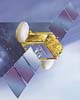 Calcutta, India (SPX) Dec 28, 2005
The successful launch Thursday of India's heaviest satellite from spaceport of Kourou in French Guyana may have boosted the country's space research efforts to yet another level, but it has also lifted the spirits of at least three Direct-To-Home televisions broadcasters, one of which has been waiting for years to launch its services in India. |
|
|

|
|
|
|
|
|
|
|
|
|
|
|
| The content herein, unless otherwise known to be public domain, are Copyright 1995-2006 - SpaceDaily.AFP and UPI Wire Stories are copyright Agence France-Presse and United Press International. ESA PortalReports are copyright European Space Agency. All NASA sourced material is public domain. Additionalcopyrights may apply in whole or part to other bona fide parties. Advertising does not imply endorsement,agreement or approval of any opinions, statements or information provided by SpaceDaily on any Web page published or hosted by SpaceDaily. Privacy Statement |