|
 |
 |
 |
 |
 |
 |
 |
 |

 |
Ariane Satellite Payloads Receive Propellants
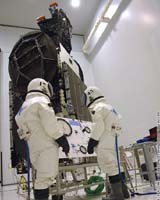
Kourou, French Guyana (SPX) May 18, 2006 Arianespace has announced the two satellite payloads to be orbited aboard the Ariane 5 ECA heavy-lift rocket have been filled with their onboard propellants. The fueling took place in the S5 satellite preparation facility, where both telecommunications spacecraft are continuing their final check-outs for the scheduled May 26 liftoff. The Thaicom 5 satellite was loaded with Monomethylhydrazine fuel in the S5 facility's S5B hall. Thaicom 5 was built by Alcatel Alenia Space and is based on the European manufacturer's Spacebus satellite design. The relay platform will be operated by Thailand's Shin Satellite Public Company Limited for Ku-band and C-band telecommunications and television services throughout the Asia/Pacific region, and is to be located at an orbital position of 78.5 degrees east longitude. Thaicom 5 will have a liftoff mass of approximately 2,800 kilograms (6,160 pounds), and will be the smaller of the two payloads carried by Ariane 5. The three-axis stabilized spacecraft will allow Shin Satellite to retire its Thaicom 1 and Thaicom 2 satellites, launched by Arianespace in 1993 and 1994, respectively. Arianespace also orbited Shin Satellite's Thaicom 1 spacecraft in 1997, and an Ariane 5 lofted the heavyweight Thaicom 4 platform in August 2005. Thaicom 4 boasted a record mass of 6,485 kilograms (14,260 pounds). Ariane 5's other payload, the Satmex 6 satellite, received its propellant in the S5A fueling hall of the S5 building. The spacecraft will have a liftoff mass of about 5,700 kilograms (12,450 pounds). It will be utilized by Satelites Mexicanos, S.A. de C.V. to provide coverage over the Continental United States, Mexico and South America. Satmex 6 is based on Space Systems/Loral's FS-1300X satellite bus and carries a mixed relay payload of 36 C-band and 24 Ku-band transponders. Community Email This Article Comment On This Article Related Links SATMEX Thaicom Arianespace Space Technology News - Applications and Research
 Revolutionary Japanese LED makes light work
 Paris (AFP) May 17, 2006
 A trio of Japanese scientists say they have invented an ultraviolet light-emitting diode (LED) that could open the way to a new generation of optical discs with very high data-storage capacity. |
|
|

| The content herein, unless otherwise known to be public domain, are Copyright 1995-2006 - SpaceDaily.AFP and UPI Wire Stories are copyright Agence France-Presse and United Press International. ESA PortalReports are copyright European Space Agency. All NASA sourced material is public domain. Additionalcopyrights may apply in whole or part to other bona fide parties. Advertising does not imply endorsement,agreement or approval of any opinions, statements or information provided by SpaceDaily on any Web page published or hosted by SpaceDaily. Privacy Statement |