|
 |
 |
 |
 |
 |
 |
 |
 |

 |
Ariane 5 - Third Dual-Payload Launch Of 2007
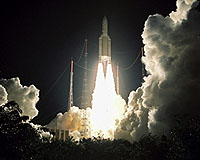
Kourou, French Guiana (SPX) Aug 16, 2007 Last night, an Ariane 5 ECA launcher lifted off from Europe's Spaceport in French Guiana on its mission to place two telecommunications satellites into geostationary transfer orbits. Lift-off of flight V177 took place at 23:44 GMT/UTC (20:44 local time, 01:44 [15 August] CEST/Paris). The satellites were accurately injected into the correct transfer orbits about 30 minutes later. The payload comprised SPACEWAY 3, which will deliver broadband services throughout North America, and BSAT-3a, which will provide direct television links for Japan. The payload mass was 8848 kg; the satellite masses totalled 8042 kg, with payload adapters and dispensers making up the additional 806 kg. This third launch of the year keeps Arianespace and Europe's Spaceport on target to perform six Ariane 5 launches in 2007 as they head towards their target of seven to eight missions per year from 2009.
Flight timeline The solid boosters were jettisoned 2min:20sec after main engine ignition, and the fairing protecting the payload during the climb through the Earth's atmosphere was discarded at 3min:08sec. The launcher's main engine was shut down at 8min:59sec; six seconds later the main cryogenic stage separated from the upper stage and its payload. Four seconds after main stage separation, the engine of the launcher's cryogenic upper stage was ignited to continue the journey. The upper stage engine was shut down at 24min:53sec into the flight, at which point the launch vehicle was travelling at 9435 m/s (almost 34 000 km/h) at an altitude of 557.5 kilometres and the conditions for geostationary transfer orbit injection had been achieved. At 27min:38sec after main engine ignition, SPACEWAY 3 separated from the launcher, followed by BSAT-3a at 34min:10sec. For this launch, an attempt is being made to recover the solid rocket boosters from the Atlantic Ocean and return them to Kourou for examination. After the boosters separate from the launch vehicle at an altitude of about 66 km and a speed of 1950 m/s (7020 km/h), their momentum carries them up to an altitude of nearly 120 km before they begin their return to Earth. When the boosters have fallen to an altitude of 5 km, by which time they are descending at 200 m/s (720 km/h), their nosecones are ejected and a parachute system is deployed. The main parachutes are 48 m in diameter and slow the descent rate of the 40 tonne booster casings to below 27 m/s (100 km/h) for landing in the sea around 8min:40sec after lift off. Community Email This Article Comment On This Article Related Links Arianespace Kourou Launch Pad at Space-Travel.com
 Lockheed Martin Marks 33rd Consecutive A2100 Success With The Launch Of BSAT-3A
 Kourou, French Guiana (SPX) Aug 16, 2007
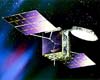
The BSAT-3a telecommunications satellite, designed and built by Lockheed Martin for the Broadcasting Satellite System Corporation (B-SAT), was successfully launched from Kourou, French Guiana. Lift-off occurred at 7:44 p.m. Eastern Daylight Time (EDT) aboard an Ariane 5-ECA launch vehicle provided by Arianespace of Evry, France. Initial contact with the satellite, called acquisition of signal, was confirmed at 8:46 p.m. EDT from Lockheed Martin's satellite tracking station in Uralla, Australia. |
|
|

| The content herein, unless otherwise known to be public domain, are Copyright 1995-2007 - SpaceDaily.AFP and UPI Wire Stories are copyright Agence France-Presse and United Press International. ESA Portal Reports are copyright European Space Agency. All NASA sourced material is public domain. Additional copyrights may apply in whole or part to other bona fide parties. Advertising does not imply endorsement,agreement or approval of any opinions, statements or information provided by SpaceDaily on any Web page published or hosted by SpaceDaily. Privacy Statement |