|
 |
 |
 |
 |
 |
 |
 |
 |

 |
Ariane 5 Ready To Launch Climate Monitoring Hub
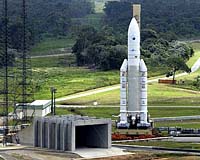
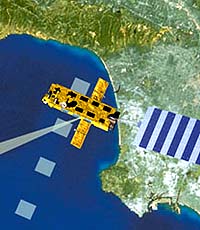
Paris (ESA) Feb 27, 2002 Europe's showpiece in climate monitoring is called Envisat. Fully equipped, the largest, most complex, and most powerful Earth observation satellite of the European Space Agency (ESA) is 25 meters high, ten meters wide and weighs over eight tons, scheduled for launch in the night of 28 February /1st March on an Ariane 5 launcher. Europe's flying behemoth is on the trail of climate change. It will deliver data about global warming, ozone depletion and climate change for at least five years. The information is absolutely necessary and long overdue as the basis for political decisions about climate change. Until now only a privileged few men and women have been able to see the Earth from outer space and to recognize how tiny and fragile it is. "I hope," said Alexei Leonow, the first cosmonaut to step out of his space vehicle, "that people understand that and protect our blue planet as their place of birth, as their common homeland, and as the ancestral home where their children and grandchildren will live after them." Envisat will fulfill this desire. With its ten instrument systems it is equipped with the best eyes possible and offers everything that scientists could wish for in the service of the environmentally endangered planet. The unique flying environment station follows in the footsteps of the successful European Earth remote sensing satellites ERS 1 (1991) and ERS 2 (1995). Climate protection is a challenge for the entire society. This is why ESA did not hold back with the budget. The total costs for the Envisat-Program were 2.3 billion euros, distributed over 15 years. Included in this sum is development and construction of the instruments as well as the satellites, the launch on board Ariane 5 and the operational costs of the satellite for five years. Each citizen of the 15 ESA Member States thereby invested 7 Euros in the environment. Put another way, Envisat will cost each European citizen about one cup of coffee per year. For his money, for at least five years, the citizen receives precise information about changes in the environment including global warming, ozone depletion and climate change. This information is absolutely necessary and long overdue as the basis for political decisions. The gas envelope of the Earth is not determined by political boundaries. The atmosphere is global and the circulation is planetary. Letting down the environmental guard is not possible in Europe or anywhere else.
The Sick Earth Atmosphere For several decades a steady increase in the atmosphere of climate-active gases has been registered. What is disturbing is that the processes are occurring by degrees. All substances released into the atmosphere have an effect, somewhere, somehow. The when, where and with which intensity and consequences is very difficult to understand because of the complexity of the climate processes and because the feed-back mechanisms are very difficult to predict. Everything is connected with everything else. "When I began to investigate the atmosphere, I concentrated exclusively on four chemical reactions which at the time were considered to be decisive", reports Paul Crutzen, who received the Nobel Prize for chemistry in 1995 for his investigation of the cause of the ozone hole. "Today we have to work with hundreds of reactions in our chemical models if we wish to understand something." One cannot say with certainty in all cases whether certain substances are neutral or harmful. The best example is CFC's. The have enjoyed a remarkable career and metamorphosis. Discovered 70 years ago, they were long considered to be absolutely harmless, neutral and to a great extent environmentally benign because they are colorless and odorless and neither poisonous, corrosive, nor combustible. They were correspondingly in wide use - as a propellant in spray cans, coolant in refrigerators and air conditioners, as foaming agent for plastic manufacture, as sterilizing agent for medical implements, as solvent and cleaning fluid for cloth and leather and as a cleaning agent for integrated circuits for the micro-electronics industry.

|