|
 |
 |
 |
 |
 |
 |
 |
 |

 |
Ariane 5 Heavy Lifter Finds Room For Military Microsats
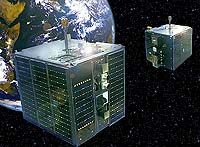
Cranleigh - Nov. 13, 2000 The second pair of Space Technology Research Vehicles (STRV-1c & 1d) to be built by the Defence Evaluation and Research Agency (DERA) are scheduled for launch from Kourou, French Guiana, on the evening of November 16. The mission is designed to speed up the introduction of the latest space technology into orbit. Between them, the box-shaped microsatellites will carry 25 different hardware experiments and four software experiments into the harsh space environment of geosynchronous transfer orbit (GTO) - 600 x 39,000 km above the Earth. This highly elliptical orbit exposes the STRV satellites to severe environmental hazards, since the satellites receive very high doses of natural radiation as they pass through the van Allen radiation belts four times a day. Over their one-year lifetime, the STRV satellites will receive radiation doses normally experienced over 8-10 years by spacecraft in low Earth and geosynchronous orbits. The satellites will also pass through harmful atomic oxygen in the Earth's upper atmosphere. By intense exposure to all of these elements, the satellites will allow the testing of new technologies and components to be accelerated. The satellites carry a suite of environmental monitors, which will give comprehensive radiation measurement, assess atomic oxygen and electrostatic charging effects and detect cosmic dust and ionospheric anomalies. These are sponsored by a wide variety of space organisations in the UK, continental Europe, the USA and Canada. A number of experiments on STRV-1c will measure high energy particles - protons in the lower van Allen belts and cosmic rays from beyond our Galaxy - that can cause serious damage to spacecraft electronics and solar power generation. Other experiments will study electrostatic charging by electrons in the van Allen belts, which can destroy a satellite's electronics. Other scientific experiments will study different aspects of the hostile space environment:
DERA's Space Department has been involved in satellite development since the late 1950s. The Department is currently building subsystems for the European Space Agency's Mars Express and Beagle 2 missions, and leads a consortium to build the TOPSAT tactical optical imaging satellite. DERA also designed and built a medium-wave infra-red camera for the U.S. Department of Defence TSX-5 satellite. Community Email This Article Comment On This Article Related Links STRV-1c and 1d Programme Defence Evaluation and Research Agency SpaceDaily Search SpaceDaily Subscribe To SpaceDaily Express Microsat News and Nanosat News at SpaceMart.com
 Small Satellite Solutions From Scotland
 Clyde, Scotland (SPX) Jan 12, 2006
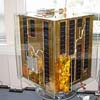
Clyde Space are offering the growing ranks of small satellite manufacturers power subsystem solutions for their missions. Based in purpose built facilities on West of Scotland Science Park in Glasgow, Clyde Space has a range of power subsystems for missions from as little as 1W up to in excess of 2.5kW. |
|
|

|
|
|
|
|
|
|
|
|
|
|
|
| The content herein, unless otherwise known to be public domain, are Copyright 1995-2006 - SpaceDaily.AFP and UPI Wire Stories are copyright Agence France-Presse and United Press International. ESA PortalReports are copyright European Space Agency. All NASA sourced material is public domain. Additionalcopyrights may apply in whole or part to other bona fide parties. Advertising does not imply endorsement,agreement or approval of any opinions, statements or information provided by SpaceDaily on any Web page published or hosted by SpaceDaily. Privacy Statement |