|
 |
 |
 |
 |
 |
 |
 |
 |

 |
Ares Tests Roll Along
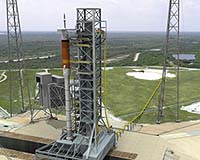
Kennedy Space Center FL (SPX) Mar 31, 2008 NASA and United Space Alliance engineers and technicians working at NASA's Kennedy Space Center tested procedures they will rely on to handle and load the propellant tanks that will be used on the roll control system of the Ares I. The latest testing on the new Ares I rocket brought together components from an Air Force missile program with support equipment invented for handling space shuttle parts. The evaluation is the latest in a series of studies at NASA's Kennedy Space Center leading up to the first test launch scheduled for April 2009. The flight will not carry any astronauts and is mainly a chance to evaluate the performance of the rocket during the first stage of flight. The roll control system is a set of thrusters aligned to turn the Ares I stack soon after liftoff to line the rocket up with its proper heading. The thruster system is the same design as the one used by the Air Force's Peacekeeper missile fleet. In fact, NASA used parts of a decommissioned Peacekeeper as stand-ins during the test for the Ares I parts. The Ares I is part of NASA's Constellation Program. The 323-foot-tall rocket is a pencil-shaped craft that uses a five-segment solid rocket booster as a first stage and a liquid-fueled upper stage. The stack is topped with an Orion spacecraft. The Ares I will loft astronauts to the International Space Station. Later missions call for the rocket to send Orion capsules on the first leg of a trip to the moon. But before astronauts can ride the new spacecraft, it has to be tested in flight. And before those flight tests can begin, the people who will prepare the rockets need to learn how to do so safely. That's where this round of testing came in. NASA's David Tomasic, a fluid systems engineer at Kennedy, said both the propellant system components and the ground support equipment the teams were trying out worked well. The team focused particularly on the helium tanks to find out how they would react when pressurized. The group also studied the large titanium tanks that will hold hypergolic fuel and oxidizer. Rather than perform the test using the hazardous fuel, though, the group filled the tanks with water and measured the results. "We learned to make some adjustments on our ground support equipment," Tomasic said. "Everything worked pretty much flawlessly." With the evaluation behind it, the team is looking forward to the arrival in September of the components that will be used in the first Ares test flight. "When you get hardware sitting down at KSC, you know you're moving," Tomasic said. Community Email This Article Comment On This Article Related Links Space Tourism, Space Transport and Space Exploration News
 Odyssey Moon Announces Commercial Launch Services Agreement
 San Diego, CA (SPX) Mar 28, 2008
Odyssey Moon has announced that it has reached a commercial launch services agreement with Celestis. The agreement provides for payload capacity aboard Odyssey Moon's lunar missions for placing memorial flight capsules and modules in lunar orbit or on the Moon. |
|
|

| The content herein, unless otherwise known to be public domain, are Copyright 1995-2007 - SpaceDaily.AFP and UPI Wire Stories are copyright Agence France-Presse and United Press International. ESA Portal Reports are copyright European Space Agency. All NASA sourced material is public domain. Additional copyrights may apply in whole or part to other bona fide parties. Advertising does not imply endorsement,agreement or approval of any opinions, statements or information provided by SpaceDaily on any Web page published or hosted by SpaceDaily. Privacy Statement |