|
 |
 |
 |
 |
 |
 |
 |
 |

 |
Arecibo Radiotelescope Identifies Hermes As Binary Asteroid
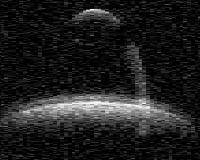
Arecibo - Oct 24, 2003 An asteroid that has eluded astronomers for decades turns out to be an unusual pair of objects traveling together in space, a planetary scientist using the National Science Foundation's (NSF) Arecibo Observatory radio telescope and his colleagues report. The asteroid Hermes was re-discovered last week after being lost for 66 years. Now Jean-Luc Margot, a researcher in the Department of Earth and Space Sciences at the University of California, Los Angeles, has determined that the asteroid is in fact two objects orbiting each other. The two objects together would cover an area approximately the size of Disneyland. Margot and colleagues are analyzing new radar measurements from the Arecibo Observatory, Puerto Rico, the world's largest single-dish radio telescope, operated by the National Astronomy and Ionosphere Center (NAIC) at Cornell University, Ithaca, N.Y., for the NSF. The astronomers are scheduled to obtain additional measurements using the Arecibo telescope this weekend (Oct. 25-26). Hermes makes frequent close approaches to Earth, Venus, Mars, as well as Vesta, the third largest asteroid in the main asteroid belt between Mars and Jupiter. While several other asteroids have satellites, the other known binaries with trajectories that cross the orbit of the Earth consist of a large primary asteroid orbited by a much smaller one. "Hermes is the first asteroid ever discovered in the near-Earth population where the two components are essentially equal in size," Margot said. "It's a very unusual binary, a puzzle. It may have formed when it swung so close to a planet that it was ripped apart by gravitational forces, but we don't know for sure. One of our goals is to learn more about the two components and how they rotate about each other in the hopes that we may be able to deduce how Hermes became a double asteroid. "Because the components are close to each other, they raise appreciable tides in each other and each has slowed down the other's spin significantly. They are now likely in a doubly synchronous state, where their spin period is equal to their orbital period. This means they constantly present the same face to each other, just like Pluto and its satellite, Charon." Hermes, was first observed in 1937 as a fast-moving bright object and then went undetected until last week, although it had circled the sun almost exactly 31 times since then, said Brian Marsden, of the Minor Planet Center in Cambridge, Mass. On Oct. 15, Brian Skiff of the Lowell Observatory Near-Earth-Object Search sighted a mysterious object; Timothy Spahr at the Minor Planet Center in Cambridge identified similarities with the 1937 observations, and Steven Chesley and Paul Chodas at NASA's Jet Propulsion Laboratory (JPL) linked the observations to Hermes. The same day, Margot and his team proposed to observe the asteroid with the Arecibo Observatory's high-powered radar system -- a proposal that was accepted within hours. The goals of the proposal were to measure precisely the distance and velocity of this object, to improve the knowledge of its trajectory and help trace back its history, to characterize Hermes' physical properties, and to search for satellites. Margot and collaborators have been given five sessions at Arecibo and five sessions at the Goldstone radar telescope in California to observe Hermes. Due to the urgent nature of the proposal, Margot observed from his home computer while his associates, Mike Nolan, Victor Negron, Alice Hine, and Don Campbell, associate director of NAIC, were at the Arecibo telescope. Hermes gets as close as 378 000 miles from Earth -- which, in astronomical terms, is quite close, about 1.6 times the distance between Earth and the moon. Orbits can change appreciably over time due to gravitational influences of the planets, noted Nolan, an Arecibo Observatory scientist. Hermes travels on an elliptical orbit and reaches deep into the inner solar system, crossing Venus' orbit. The new research has made it possible to extend the time interval over which the trajectory can be computed reliably, said Jon Giorgini, a senior engineer at JPL and member of the team. "As far as impact risk, there is no cause for worry in our lifetimes," Giorgini said. "Over hundreds of thousands or millions of years, Hermes could impact the Earth, but only if it doesn't hit Venus first." Margot and colleagues described their observations and data in an International Astronomical Union Circular this week. Margot's research is funded by NASA. His co-authors are Nolan, Negron, Hine, Campbell, and Ellen Howell at NAIC; Lance Benner, Steven Ostro, and Giorgini at JPL; and Marsden at the Minor Planet Center. Community Email This Article Comment On This Article Related Links Cornell UCLA SpaceDaily Search SpaceDaily Subscribe To SpaceDaily Express Asteroid and Comet Mission News, Science and Technology
 NASA'S Spitzer Finds Possible Comet Dust Around Dead Star
 Pasadena CA (SPX) Jan 12, 2006
NASA's Spitzer Space Telescope has spotted what may be comet dust sprinkled around the white dwarf star G29-38, which died approximately 500 million years ago.
--------------------------------------------------------- It's new. And it's downright terrific! Celestron's CPC Schmidt-Cassegrain telescope is the scope you've been waiting for! It offers new alignment technology, advanced engineering, and bold new design at a new, low price! In fact, Celestron's Professional Computerized (CPC) scope with revolutionary SkyAlign Alignment Technology redefines everything that amateur astronomers are looking for. It offers quick and simple alignment, GPS technology, unsurpassed optical quality, ease of use, advanced ergonomics, enhanced computerization and, most important, affordability. Want to view M-31 tonight? One button takes you there!
Shop for telescopes online at Telescopes.com! today!
|
|
|

| The content herein, unless otherwise known to be public domain, are Copyright 1995-2006 - SpaceDaily.AFP and UPI Wire Stories are copyright Agence France-Presse and United Press International. ESA PortalReports are copyright European Space Agency. All NASA sourced material is public domain. Additionalcopyrights may apply in whole or part to other bona fide parties. Advertising does not imply endorsement,agreement or approval of any opinions, statements or information provided by SpaceDaily on any Web page published or hosted by SpaceDaily. Privacy Statement |