|
 |
 |
 |
 |
 |
 |
 |
 |

 |
Arecibo Detector Is Discovering Thousands Of Galaxies
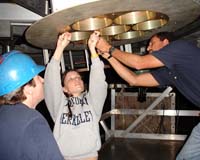
Ithaca, N.Y. (SPX) March 9, 2006 A series of sky surveys using the Arecibo radio telescope's ALFA receiver in Puerto Rico has produced what its research team calls "a wealth of new data." The washing-machine-sized ALFA system of detectors and associated electronics, built jointly by engineers at the National Astronomy and Ionosphere Center (Arecibo) and in Australia, allowing researchers to image large swaths of sky and search for such time-variable phenomena as pulsars seven times more efficiently than in the past. "You could very well say it's a new phase for Arecibo," said Jim Cordes of Cornell University, one of the principal scientists involved in ALFA's conception. "We're doing things that are pretty unique to what Arecibo can do - playing on its strengths." Cordes uses ALFA to find and observe pulsars - massive rapidly spinning neutron stars ejected in supernovae � the data from which he thinks could lead to a deeper understanding of Einstein's theory of relativity. "ALFA is going to discover probably 1,000 new pulsars that we haven't seen yet," said Stephen Torchinsky, ALFA's former project manager. "The expectation is that we're going to find some exotic objects. We could use these systems to test the limits of the theory of relativity - and at the most extreme cases, to find gravitational waves." ALFA's surveys, which include searching for sources of neutral hydrogen in the Milky Way, and sources of radio waves in other galaxies, is providing an abundance of data. "It's like you have seven fire hoses of data coming at you," Cordes said. "It's really a challenge to deal with." Scientists at Cornell's Theory Center are creating a new computer system to manage vast amounts of data from such surveys as the Arecibo Legacy Fast ALFA survey, or ALFALFA, a broad extragalactic search for faint cosmic radio signals from hydrogen clouds. ALFALFA is expected to detect some 20,000 galaxies from as far away as 750-million light-years over the next six years. The team hopes the survey will lead to the discovery of dark galaxies - never-before-observed objects composed largely of dark matter and hydrogen gas that could offer valuable information about the way galaxies form and evolve. "Without ALFA, a project like this could not have been done," said Riccardo Giovanelli, ALFALFA's project leader. "It would have been too demanding on a few people." In ALFA's two years of operation, the number of its users at Arecibo has jumped by nearly 50 percent, to 335 in 2005 from 215 in 2003 - and many are graduate students. "We're bringing new users to Arecibo," said Martha Haynes, a member of the ALFALFA team. "The goal of the major surveys is to produce archival databases that are accessible to all researchers and will be valuable resources for many decades to come," said Robert Brown, NAIC's director. Community Email This Article Comment On This Article Related Links ALFA ARECIBO Stellar Chemistry, The Universe And All Within It
 Astronomers Find Origin Of Extreme-Helium Stars
 Austin, Texas (SPX) March 9, 2006
Austin, Texas (SPX) March 9, 2006 Astronomers have determined the origin of a very unusual and rare type of star. New data indicate that extreme-helium stars, as they are called, form from the merger of two white dwarfs. |
|
|

| The content herein, unless otherwise known to be public domain, are Copyright 1995-2006 - SpaceDaily.AFP and UPI Wire Stories are copyright Agence France-Presse and United Press International. ESA PortalReports are copyright European Space Agency. All NASA sourced material is public domain. Additionalcopyrights may apply in whole or part to other bona fide parties. Advertising does not imply endorsement,agreement or approval of any opinions, statements or information provided by SpaceDaily on any Web page published or hosted by SpaceDaily. Privacy Statement |