
 |
 |
 |
 |
 |
 |
 |
 |
 |

 |
Arctic sheds huge chunks of ice
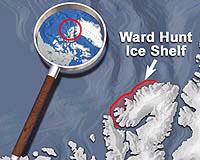
Montreal (AFP) July 30, 2008 Two masses of ice together measuring almost 20 square kilometers (seven square miles) have broken off an Arctic ice shelf, the biggest breakup of Arctic ice in three years, Canadian officials announced. The chunks broke off from the Ward Hunt Ice Shelf on the coast of Ellesmere Island in the Canadian Arctic Archipelago, forming two floating islands of ice measuring four to five square kilometers (1.9 square miles) and 14 square kilometers (5.4 square miles), officials said. "The first broke off sometime around July 22 and the second in the night of July 23 to 24," Luc Desjardins, a senior iceberg forecaster for the Canadian Ice Service, told AFP Tuesday, noting that beads of smaller slabs also detached from the ice shelf and are now adrift. Scientists confirmed the schism in a fly-over of one of the resulting masses of ice and by analyzing satellite data. It was the largest breakup of an ice shelf in the Arctic since the Ayles Ice Shelf split off Ellesmere Island in 2005 and formed a floating island roughly the size of New York city's Manhattan, or about 66 square kilometers (25 square miles). The August 2005 rupture caused such a splash, the burst was detected by Canadian seismology equipment 250 kilometers (155 miles) away, but it was not until scientists analyzed satellite data that they realized what had happened. Five vast ice shelves gird the north side of Ellesmere Island in Canada's Nunavut territory. Ward Hunt is considered the largest, with a surface area of 443 square kilometers (171 square miles). The ice shelves, vast plateaus of thick ice floating on the ocean but attached to land, began to form more than 4,000 years ago, scientists believe. "We ascertained that in the 20th century 90 percent of the ice surface area (in the region) has been lost," said Derek Mueller, a Polar specialist at Trent University in Peterborough. "So, this phenomena has been ongoing on for a long time, but we're now seeing punctuated events," he said. He pointed to the Petersen Ice Shelf which lost a third of its surface area between 2005 and 2007, as an example. This calving is emblematic of the far north's warming, say other scientists. A fissure formed at the center of the Ward Hunt Ice Shelf in 2002, leaving a lip of ice clinging to Ellesmere Island. A new crack measuring 18 kilometers (11 miles) long and 40 meters (131 feet) deep was discovered earlier this year. But "it doesn't look like the latest breakup of ice is directly tied to the fracture that was detected in the spring," said Desjardins. "The 2002 fissure cut the ice shelf in two pieces. I believe over time the shelf's integrity, its entire structure, was simply weakened," Mueller explained. Community Email This Article Comment On This Article Share This Article With Planet Earth
Related Links Beyond the Ice Age
 Unmanned flights give peek at melting ice
 Washington (UPI) Jul 16, 2008
 Aircraft flying over Greenland will offer a view of the melting Greenland Ice Sheet and its potential for raising the global sea level, U.S. scientists said. |
|
|

| The content herein, unless otherwise known to be public domain, are Copyright 1995-2007 - SpaceDaily.AFP and UPI Wire Stories are copyright Agence France-Presse and United Press International. ESA Portal Reports are copyright European Space Agency. All NASA sourced material is public domain. Additional copyrights may apply in whole or part to other bona fide parties. Advertising does not imply endorsement,agreement or approval of any opinions, statements or information provided by SpaceDaily on any Web page published or hosted by SpaceDaily. Privacy Statement |
 del.icio.us
 Digg
Digg Reddit
 YahooMyWeb
 Google
 Facebook