|
 |
 |
 |
 |
 |
 |
 |
 |

 |
Arctic Region As Global Warming Barometer
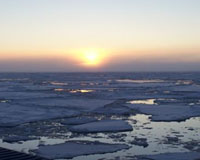
Tromsoe, Norway (AFP) Jan 25, 2007 The Arctic Ocean's pack ice is expected to disappear entirely in the coming decades and will bring unforeseeable changes to the region, international experts meeting this week in Norway said. For many participants at the Arctic Frontiers conference held in the northern Norwegian town of Tromsoe, 2,000 kilometres (1,200 miles) south of the North Pole, the pace of global warming is staggering. "Climate change in the Arctic is not coming. It is here," said Canadian researcher at the University of Manitoba, David Barber. Barber predicts that between 2030 and 2050, the Arctic's sea ice will have disappeared completely during the summer months. "Last time something like that happened was a million years ago. It is a tremendous change," Barber added. Climate models presented by speakers at the conference all tell the same story. Melting ice sheets -- equivalent to some 70,000 square kilometres (27,000 square miles) a year -- as well as sharp rises in temperatures since the end of the 1990s and the failure of sea ice to recover ground lost during the summer months all characterise changes in the region. "It is very likely that the ecology of the Arctic will change dramatically over the next decades. These changes will occur and are occurring to an ecosystem that we know very little about," said Richard Bellerby, a researcher at Norway's University of Bergen. Bellerby studies the increasing acidity of the Arctic Ocean, a relatively new area of research. The waters of the ocean have become more acidic in line with increasing emissions of greenhouse gases. A development that could, according to Bellerby, lead to the extinction of certain marine organisms, especially plankton, altering the ocean's entire ecosystem. The steady disappearance of the ocean's ice cover is reported in all regions of the Arctic. "We are seeing catastrophic changes in sea ice cover in the Pacific section of the Arctic Ocean," said Jackie Grebmeier, professor at the University of Tennessee. "It can cascade very quickly. Since the late 1990s, ice melt is happening weeks earlier. Ramifications can be exponential," she added. According to the director of the Norwegian section of the World Wide Fund for Nature (WWF), Rasmus Hansson, the change "is happening so extremely fast, much much faster than we have seen in thousands and thousands of years. It could have an unpredictable result." One consequence of the warming of the Arctic that is already apparent is the movement of fish such as cod ever farther north from previously cooler waters. For some years, the Nordic countries' indigenous people, the Sami, have reported changes to their way of life caused by milder temperatures. "The winters are getting warmer, the vegetation is changing and it has consequences for the reindeer that graze in winter ... they cannot reach lichen," the speaker of the Sami parliament Aili Keskitalo said. "Insects are more numerous, worms are eating the birch leaves, all this because we did not experience in the last winters ... the (typical) temperatures of minus 35 to 40 C (minus 31 to 40 F)," she added. According to some attending the conference, the warming of the Arctic -- considered a harsh but unspoiled frontier -- could be positive. The changes in the region could serve as a wake-up call for the dangers of global warming. "The Arctic is an early warning system. It can help people understand what is going on," Barber said.
Source: Agence France-Presse Community Email This Article Comment On This Article Related Links Beyond the Ice Age Learn about Climate Science at TerraDaily.com Beyond the Ice Age
 A Wanderlust Of Deep-Sea Fauna Under Antarctic Ice Shelf
 Bremerhaven, Germany (SPX) Jan 25, 2007
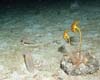
Under the former Larsen ice shelf east of the Antarctic Peninsula, deep-sea sea cucumbers and stalked feather stars were ubiquitously found in shallow waters. These animals usually inhabit far greater water depths. The main aim of the current Polarstern expedition to Antarctica is the investigation of marine ecosystems under the former Larsen ice shelf. |
|
|

| The content herein, unless otherwise known to be public domain, are Copyright 1995-2006 - SpaceDaily.AFP and UPI Wire Stories are copyright Agence France-Presse and United Press International. ESA PortalReports are copyright European Space Agency. All NASA sourced material is public domain. Additionalcopyrights may apply in whole or part to other bona fide parties. Advertising does not imply endorsement,agreement or approval of any opinions, statements or information provided by SpaceDaily on any Web page published or hosted by SpaceDaily. Privacy Statement |