|
 |
 |
 |
 |
 |
 |
 |
 |

 |
Arctic Fever Getting Hotter
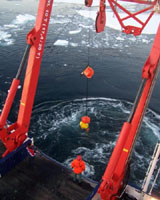
Bremerhaven, Germany (SPX) Oct 05, 2006 Several days ago, the 'Maria S Merian' returned from her second Arctic expedition with data confirming trends of Arctic warming. "Compared to last summer, the water that flows from the Norwegian Sea to the Arctic has been an average 0.8 degrees Celsius warmer this summer," says expedition leader Dr Ursula Schauer of the Alfred Wegener Institute for Polar and Marine Research. "This is in addition to the last two years already having been warmer than the previous 20 from which we have regular measurements. Over the Yermak Plateau, an oceanic ridge, the oceanographers documented water of more than four degrees Celsius moving up to 81 20' northern latitude," according to Schauer. During the expedition, biologists discovered zooplankton species from the Norwegian Sea which were previously unrecorded from the northern latitudes that they had reached via the warm waters. For one month, scientists of the Alfred Wegener Institute, the University of Bremen and the Polish Institute of Oceanology were tracking warm waters along the sea ice margin between Greenland and Spitsbergen. As the sea ice margin was far north this year, the 'Maria S Merian' reached its northernmost position yet at 81 20'N. In Fram Strait, the scientists continued oceanographic and biological long-term studies that were initiated ten years ago. The climate change observed throughout the past ten years is particularly marked in the Arctic. Oceanographers are working towards a better understanding of the oceans' role in this process. How much heat is transmitted to the Arctic by the northernmost subsidiary of the warm North Atlantic Current, and how much variation is found in this heat pump, are some of the open questions. For this purpose, the transport of warm, high salinity water from the Atlantic to the Arctic has been recorded in the strait between Greenland and Spitsbergen, using an elaborate fixture system. Previous measurements have indicated the occurrence of several strong warm pulses during the past decade. Within the context of an international programme, a combination of this and similar data has, for the first time, enabled reconstruction of an Atlantic heat pulse through the Norwegian Sea and far into the inner Arctic over several years. In order to continue the time series, the scientists have collected the instruments deployed in Fram Strait and replaced them with new ones. The automated long-term recordings are verified and complemented with high resolution measurements of current water temperature. Community Email This Article Comment On This Article Related Links Alfred Wegener Institute for Polar and Marine Research Beyond the Ice Age Learn about Climate Science at TerraDaily.com Climate Science News - Modeling, Mitigation Adaptation
 Arctic Sea Ice Declines Again In 2006
 Boulder CO (SPX) Oct 05, 2006
While cool August temperatures prevented sea ice in the Arctic from reaching its lowest summer extent on record, 2006 continued a pattern of sharp annual decreases due to rising temperatures probably caused by greenhouse warming, according to University of Colorado at Boulder researchers. |
|
|

| The content herein, unless otherwise known to be public domain, are Copyright 1995-2006 - SpaceDaily.AFP and UPI Wire Stories are copyright Agence France-Presse and United Press International. ESA PortalReports are copyright European Space Agency. All NASA sourced material is public domain. Additionalcopyrights may apply in whole or part to other bona fide parties. Advertising does not imply endorsement,agreement or approval of any opinions, statements or information provided by SpaceDaily on any Web page published or hosted by SpaceDaily. Privacy Statement |