
 |
 |
 |
 |
 |
 |
 |
 |
 |

 |
Archaeologists Trace Early Irrigation Farming In Ancient Yemen
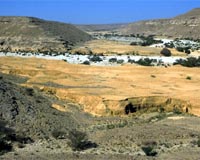
Toronto, Canada (SPX) Jul 21, 2008 In the remote desert highlands of southern Yemen, a team of archaeologists have discovered new evidence of ancient transitions from hunting and herding to irrigation agriculture 5,200 years ago. As part of a larger program of archaeological research, Michael Harrower from the University of Toronto and The Roots of Agriculture in Southern Arabia (RASA) team explored the Wadi Sana watershed documenting 174 ancient irrigation structures, modeled topography and hydrology, and interviewed contemporary camel and goat herders and irrigation farmers. "Agriculture in Yemen appeared relatively late in comparison with other areas of the Middle East, where farming first developed near the end of the last ice age about 12,000 years ago," says author Michael Harrower, Department of Anthropology, University of Toronto. "It's clear early farmers in Yemen faced unique environmental and social opportunities and challenges. Our findings show farming in southern Yemen required runoff diversion technologies that were adapted to harness monsoon (summer) runoff from the rugged terrain along with new understandings of social landscapes and rights to scarce water resources." The researchers used computer Geographic Information Systems (GIS) mapping to determine that ancient forager-herders developed expert knowledge of hydrology and targeted particular small watersheds and landforms for irrigation. Studies of contemporary land and water rights, including principles enshrined in Islamic law, suggest their origins lie at the very beginnings of water management as tribal principles of water equity intertwined with changing ideologies and culture. These and other discoveries in southern Arabia have recently helped document the diversity of transitions from foraging to agriculture that in Yemen later gave rise to powerful ancient cities and states with advanced irrigation technologies that transformed deserts into lush, bountiful oases. Community Email This Article Comment On This Article Share This Article With Planet Earth
Related Links University of Toronto All About Human Beings and How We Got To Be Here
 Will Our Future Brains Be Smaller
 Bristol, UK (SPX) Jul 10, 2008
The speed at which we react to threatening situations can have life or death implications. In the more primitive past, it could have meant escaping a wild animal; today it might mean swerving to avoid a head-on car crash. |
|
|

| The content herein, unless otherwise known to be public domain, are Copyright 1995-2007 - SpaceDaily.AFP and UPI Wire Stories are copyright Agence France-Presse and United Press International. ESA Portal Reports are copyright European Space Agency. All NASA sourced material is public domain. Additional copyrights may apply in whole or part to other bona fide parties. Advertising does not imply endorsement,agreement or approval of any opinions, statements or information provided by SpaceDaily on any Web page published or hosted by SpaceDaily. Privacy Statement |
 del.icio.us
 Digg
Digg Reddit
 YahooMyWeb
 Google
 Facebook