|
 |
 |
 |
 |
 |
 |
 |
 |

 |
Apollo 14 Samples Provide Dating Evidence
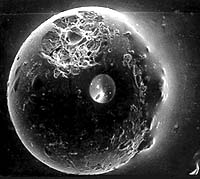
Berkeley - March 9, 2000 - The team initially tested beads from rock collected by Apollos 11 and 12, but they became discouraged when initial results did not give them sufficient precision. Culler concluded, however, that most of the beads came from impacts relatively near the sample site, and so deduced that samples from Apollo 14 - collected from an area with high potassium content, essential for accurate dating - would yield the needed precision. He was right. Culler, Becker and Renne analyzed 155 beads from one gram of lunar soil picked up in 1971 by Apollo 14 from the Fra Mauro formation - a lunar highland bordering Mare Imbrium. The mineral composition of each bead was determined with a microprobe before it was laser melted and the argon gas captured for isotopic analysis. Contrary to assumptions, they found that the cratering rate on the moon has not been constant over its history. Approximately twice as many impacts occurred between 4 and 3 billion years ago as occurred between 2 and 1/2 billion years ago. About 500 million years ago the intensity of impacts increased nearly to what it was at the peak of activity 3.2 billion years ago. Though the dating method was not sensitive enough to reveal a 26 million-year cycle in the impact record, "these findings fit in nicely with the Nemesis theory," Muller said. "I think most of the debris came from perturbations in the outer solar system by Nemesis." For the future, Renne says, it is "critical to launch new lunar sampling missions targeted to areas rich in potassium," in order to confirm the results and probe further back into the moon's history. The project was funded by the Ann and Gordon Getty Foundation, through the Berkeley Geochronology Center and Richard Muller. NASA provided the lunar samples. --- A PRIMAL RAIN Part One - Part Two
Email This Article Comment On This Article Related Links Space
 Satellite Launch To Boost DTH In India
 Calcutta, India (SPX) Dec 28, 2005
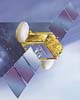
The successful launch Thursday of India's heaviest satellite from spaceport of Kourou in French Guyana may have boosted the country's space research efforts to yet another level, but it has also lifted the spirits of at least three Direct-To-Home televisions broadcasters, one of which has been waiting for years to launch its services in India. |
|
|

|
|
|
|
|
|
|
|
|
|
|
|
| The content herein, unless otherwise known to be public domain, are Copyright 1995-2006 - SpaceDaily.AFP and UPI Wire Stories are copyright Agence France-Presse and United Press International. ESA PortalReports are copyright European Space Agency. All NASA sourced material is public domain. Additionalcopyrights may apply in whole or part to other bona fide parties. Advertising does not imply endorsement,agreement or approval of any opinions, statements or information provided by SpaceDaily on any Web page published or hosted by SpaceDaily. Privacy Statement |