|
 |
 |
 |
 |
 |
 |
 |
 |

 |
Anyone For A Jolt Into Space
London - Dec. 7, 2000 If you thought warp drive was weird, try jolt propulsion. A juddering magnet has inspired a scientist at the US Department of Energy to investigate a bizarre new way of propelling a spacecraft. The idea for a "judder-drive" struck David Goodwin when he noticed that powerful cryogenically cooled superconducting magnets often jolt in one direction for a centimetre or two when you first turn them on. "If you have something metal in the magnetic field as it is forming, you see the magnet physically shift," Goodwin, who works at the Office of High Energy and Nuclear Physics in Germantown, Maryland, told New Scientist. Superconducting magnets are cooled to such a low temperature that they have no electrical resistance. Goodwin's magnets were made by taking superconducting wires of niobium-tin alloy and twisting the strands into a cable. The cables were then coated with an insulator and wound into a coil. "The coil's then put into a cylindrical casing called a cryostat that's filled with liquid helium," says Goodwin. The liquid helium cools the wire coil to -269 C, when they become superconducting. Goodwin says the metal objects create the judder effect by inducing a "brief asymmetry in the magnetic field" as it is set up when the magnet is turned on. This initial disturbance of the magnetic field, he says, creates a repulsive force on the magnet and pushes it away. But the force produced in one jolt is very low, Goodwin says, so you would need to turn the magnet on and off with ultrafast switches, making a fast stream of jolts. "We've got switches now that can work at high voltages at 400,000 times a second," he says. "If you could use one of these switches to rapidly switch the magnet on and off, you might get some propulsion out of it." A colleague of Goodwin's at Brookhaven National Laboratory in New York is now modelling the magnetic field of superconducting magnets to work out how best to arrange a metallic disc in the magnetic field to produce the biggest jolt. But Goodwin admits the judder drive might be going nowhere fast. "It's very speculative. We don't know if it'll work," he says. Marc Millis, who heads NASA's breakthrough propulsion physics project at the NASA Glenn Research Center at Lewis Field in Cleveland, Ohio, has invited Goodwin to present his idea at a propulsion conference in July next year. The crucial thing, says Millis, is whether Goodwin's magnet would produce any net motion at all -- it might just sit there and vibrate. "It's a definite possibility that any forces arising from Goodwin's concept will only act within the components of the device itself, resulting in no net force," he says. "There are a lot of unresolved physics issues to address." This article appeared in the Dec 9 issue of New Scientist New Scientist. Copyright 2000 - All rights reserved. The material on this page is provided by New Scientist and may not be published, broadcast, rewritten or redistributed without written authorization from New Scientist. CommunityEmail This Article Comment On This Article Related Links Brookhaven National Laboratory SpaceDaily Search SpaceDaily Subscribe To SpaceDaily Express Space Technology News - Applications and Research
 Industry Team Achieve New Communications Technology With AESA Radars
 Baltimore MD (SPX) Jan 12, 2006
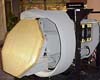
A team comprised of three leading US aerospace and defense contractors has demonstrated an innovative technological use of active electronically scanned array (AESA) radars for high-bandwidth communications. |
|
|

|
|
|
|
|
|
|
|
|
|
|
|
| The content herein, unless otherwise known to be public domain, are Copyright 1995-2006 - SpaceDaily.AFP and UPI Wire Stories are copyright Agence France-Presse and United Press International. ESA PortalReports are copyright European Space Agency. All NASA sourced material is public domain. Additionalcopyrights may apply in whole or part to other bona fide parties. Advertising does not imply endorsement,agreement or approval of any opinions, statements or information provided by SpaceDaily on any Web page published or hosted by SpaceDaily. Privacy Statement |