|
 |
 |
 |
 |
 |
 |
 |
 |

 |
Antaris GPS Receiver Has First Fix In Four Seconds
Heilbronn (SPX) May 20, 2004 Atmel Corporation and u-blox announced today that the ANTARIS GPS technology, jointly developed by Atmel and u-blox, now features an innovative 'aiding' functionality, which makes time to first fix within four seconds a reality. Aiding is just one of several features in the ANTARIS receivers which provide accurate, reliable and robust navigation anywhere and anytime. The ANTARIS-based GPS receivers provide an aiding solution for applications requiring instant position fixes, for example the E911/E112 emergency caller localisation in mobile phones, location-based services without waiting time, and un-tethered asset tracking devices. Aiding information, supplied from an external source, for example a base station, reduces the time to first accurate fix to just four seconds. The aiding parameters provide ephemeris, almanac, rough initial position, clock drift and time, satellite status and, if available, a precise time synchronisation signal. With this information, the GPS receiver has immediate knowledge of the satellites to search and track. The ANTARIS technology jointly developed by Atmel and u-blox excel in robust performance in any static and dynamic environment, particularly in the most challenging metropolitan areas. It provides -150 dBm sensitivity without compromising navigation accuracy, advanced WAAS/EGNOS support, excellent acquisition performance such as 34 s cold start, excellent multipath suppression, 4 Hz update rate, low power consumption and enables system solutions with minimum bill-of-material costs. "Since aiding functionality is becoming a strong request in the mobile GPS market, more and more customers will enjoy the benefits of Atmel's and u-blox' leading edge technology," stated Marcus Boehringer, GPS Product Manager at Atmel. "The performance and flexibility of the ANTARIS technology makes it to one of the best GPS solutions in the market today." "The innovation leaps like instant positioning by aiding are proof of the excellent capabilities of u-blox and Atmel, and are beneficial to many applications without additional cost," says Thomas Seiler, CEO of u-blox. "Also our customers can protect their investment using the ANTARIS GPS receiver platform and profit from the continuously upgraded performance with additional feature sets." The aiding feature is available in the u-blox ANTARIS GPS receiver macro components TIM-LP, TIM-LF and TIM-LC as well as on the ANTARIS GPS chipset available from Atmel without additional cost. Samples of the GPS chip set (receiver IC ATR0600 in QFN28 package measuring only 5 x 5 mm; baseband IC ATR0620 in a 9 x 9 mm 100-pin BGA package; and LNA IC ATR0610 in a very small 1.6 mm x 2.0 mm PLLP6 package) are available now. Various support packages comprising extensive documentation and a highly sophisticated low-power reference design are also available. Community Email This Article Comment On This Article Related Links u-blox Atmel SpaceDaily Search SpaceDaily Subscribe To SpaceDaily Express GPS Applications, Technology and Suppliers
 Galileo GIOVEA Using Marotta Equipment For Its Propulsion Systems
 Cheltenham, England (SPX) Jan 09, 2006
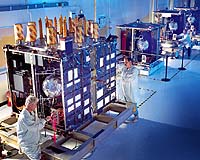
Marotta UK is pleased to announce that it designed, developed and qualified equipment for the cold gas propulsion systems on board the Galileo GIOVE-A, part of Europe's Galileo navigation program, successfully launched by Surrey Satellite Technology (SSTL). |
|
|

| The content herein, unless otherwise known to be public domain, are Copyright 1995-2006 - SpaceDaily.AFP and UPI Wire Stories are copyright Agence France-Presse and United Press International. ESA PortalReports are copyright European Space Agency. All NASA sourced material is public domain. Additionalcopyrights may apply in whole or part to other bona fide parties. Advertising does not imply endorsement,agreement or approval of any opinions, statements or information provided by SpaceDaily on any Web page published or hosted by SpaceDaily. Privacy Statement |