|
 |
 |
 |
 |
 |
 |
 |
 |

 |
Antarctic Temperatures Disagree With Climate Model Predictions
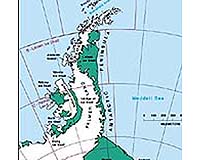
Columbus OH (SPX) Feb 16, 2007 A new report on climate over the world's southernmost continent shows that temperatures during the late 20th century did not climb as had been predicted by many global climate models. This comes soon after the latest report by the Intergovernmental Panel on Climate Change that strongly supports the conclusion that the Earth's climate as a whole is warming, largely due to human activity. It also follows a similar finding from last summer by the same research group that showed no increase in precipitation over Antarctica in the last 50 years. Most models predict that both precipitation and temperature will increase over Antarctica with a warming of the planet. David Bromwich, professor of professor of atmospheric sciences in the Department of Geography, and researcher with the Byrd Polar Research Center at Ohio State University, reported on this work at the annual meeting of the American Association for the Advancement of Science at San Francisco. "It's hard to see a global warming signal from the mainland of Antarctica right now," he said. "Part of the reason is that there is a lot of variability there. It's very hard in these polar latitudes to demonstrate a global warming signal. This is in marked contrast to the northern tip of the Antarctic Peninsula that is one of the most rapidly warming parts of the Earth." Bromwich says that the problem rises from several complications. The continent is vast, as large as the United States and Mexico combined. Only a small amount of detailed data is available - there are perhaps only 100 weather stations on that continent compared to the thousands spread across the U.S. and Europe . And the records that we have only date back a half-century. "The best we can say right now is that the climate models are somewhat inconsistent with the evidence that we have for the last 50 years from continental Antarctica . "We're looking for a small signal that represents the impact of human activity and it is hard to find it at the moment," he said. Last year, Bromwich's research group reported in the journal Science that Antarctic snowfall hadn't increased in the last 50 years. "What we see now is that the temperature regime is broadly similar to what we saw before with snowfall. In the last decade or so, both have gone down," he said. In addition to the new temperature records and earlier precipitation records, Bromwich's team also looked at the behavior of the circumpolar westerlies, the broad system of winds that surround the Antarctic continent. "The westerlies have intensified over the last four decades of so, increasing in strength by as much as perhaps 10 to 20 percent," he said. "This is a huge amount of ocean north of Antarctica and we're only now understanding just how important the winds are for things like mixing in the Southern Ocean." The ocean mixing both dissipates heat and absorbs carbon dioxide, one of the key greenhouse gases linked to global warming. Some researchers are suggesting that the strengthening of the westerlies may be playing a role in the collapse of ice shelves along the Antarctic Peninsula. "The peninsula is the most northern point of Antarctica and it sticks out into the westerlies," Bromwich says. "If there is an increase in the westerly winds, it will have a warming impact on that part of the continent, thus helping to break up the ice shelves, he said. "Farther south, the impact would be modest, or even non-existent." Bromwich said that the increase in the ozone hole above the central Antarctic continent may also be affecting temperatures on the mainland. "If you have less ozone, there's less absorption of the ultraviolet light and the stratosphere doesn't warm as much." That would mean that winter-like conditions would remain later in the spring than normal, lowering temperatures. "In some sense, we might have competing effects going on in Antarctica where there is low-level CO2 warming but that may be swamped by the effects of ozone depletion," he said. "The year 2006 was the all-time maximum for ozone depletion over the Antarctic." Bromwich said the disagreement between climate model predictions and the snowfall and temperature records doesn't necessarily mean that the models are wrong. "It isn't surprising that these models are not doing as well in these remote parts of the world. These are global models and shouldn't be expected to be equally exact for all locations," he said. Community Email This Article Comment On This Article Related Links Ohio State University Beyond the Ice Age Learn about Climate Science at TerraDaily.com Beyond the Ice Age
 Glaciers Not On Simple Upward Trend Of Melting
 Boulder CO (SPX) Feb 13, 2007
Two of Greenland's largest glaciers shrank dramatically and dumped twice as much ice into the sea during a period of less than a year between 2004 and 2005. And then, less than two years later, they returned to near their previous rates of discharge. |
|
|

| The content herein, unless otherwise known to be public domain, are Copyright 1995-2006 - SpaceDaily.AFP and UPI Wire Stories are copyright Agence France-Presse and United Press International. ESA PortalReports are copyright European Space Agency. All NASA sourced material is public domain. Additionalcopyrights may apply in whole or part to other bona fide parties. Advertising does not imply endorsement,agreement or approval of any opinions, statements or information provided by SpaceDaily on any Web page published or hosted by SpaceDaily. Privacy Statement |