
 |
 |
 |
 |
 |
 |
 |
 |
 |

 |
Antarctic Research Helps Shed Light On Climate Change On Mars
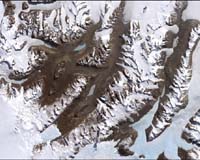
Boston MA (SPX) Sep 01, 2008 Researchers examining images of gullies on the flanks of craters on Mars say they formed as recently as a few hundred thousand years ago and in sites once occupied by glaciers. The features are eerily reminiscent of gullies formed in Antarctica's mars-like McMurdo Dry Valleys. The parallels between the Martian gullies and those in Antarctica's McMurdo Dry Valleys were made using the latest high-resolution images and technology from satellites orbiting Mars to observe key details of their geological setting. On Mars, the gullies appear to originate from cirque-like features high on pole-facing crater-interior walls, especially those within the Newton crater, 40 degrees south, examined for the study. In addition to the cirque-like features, the evidence cited for former glaciation includes bowl-shaped depressions fringed by lobate, viscous-flow deposits that extend well out onto the crater floor. "These bowl-shaped depressions reflect the former location of relatively pure glacier ice," noted David R. Marchant, an Associate Professor of Earth Sciences at Boston University, and co-author of the study published in the August 25th issue of the Proceedings of the National Academy of Sciences with James W. Head of Brown University, lead author, and Mikhail A. Kreslavsky of the University of California, Santa Cruz. As conditions on Mars shifted toward reduced snowfall at this site, clean ice on the crater wall sublimated, leaving a hole, whereas ice containing appreciable rock-fall debris out on the crater floor became covered with thin rubble, preventing complete volatile loss. But even as the last glaciers vanished, minor snow likely continued to fall. "This late-stage snow could accumulate in depressions on the crater wall and, in favorable microclimate settings, melt to produce the observed gullies and fans," said Marchant. "The results", he said, "are exciting because they establish a spatial link between recent gullies and accumulation of glacier ice, strengthening the case for surface melt water flow in the formation of gullies on Mars". Other candidate processes include dry debris flows and melting of shallow ground ice, but the sequence of events demonstrating recent snowfall in Newton Crater make surface melting of snow banks an appealing choice. In fact, both Marchant and Head have observed similar processes at work in the development of modern gullies within some of the coldest and driest regions of Antarctica. The authors conclude that changes in the rate and accumulation of snow in Newton Crater are likely related to changes in the inclination of Mars' spin access, or obliquity. At obliquities even greater than those postulated for glaciation of Newton Crater, the same authors and colleagues postulated even larger-scale mountain glaciation near the equator, on and extending out from the Tharsis volcanoes. The evidence suggests a link between obliquity, mid-latitude glaciation, and gully formation on Mars. Rather than being a dead planet, the new data are consistent with dynamic climate change on Mars, and with episodes of alpine glaciation and melt water formation in the recent past that rival modern alpine glaciation and gully formation in the coldest and driest mountains of Antarctica. Community Email This Article Comment On This Article Share This Article With Planet Earth
Related Links Boston University Mars News and Information at MarsDaily.com Lunar Dreams and more
 Making Sense Of Mars Methane
 Moffett Field CA (SPX) Jun 10, 2008
In a quest to understand the source of methane detected in the atmosphere of Mars, NASA scientists are looking at methane bubbling from the ground at an outdoor salt factory on Mexico's Baja Peninsula. By measuring carbon isotopes in the Mexican methane, these scientists hope to help unravel the mystery of the martian methane. |
|
|

| The content herein, unless otherwise known to be public domain, are Copyright 1995-2007 - SpaceDaily.AFP and UPI Wire Stories are copyright Agence France-Presse and United Press International. ESA Portal Reports are copyright European Space Agency. All NASA sourced material is public domain. Additional copyrights may apply in whole or part to other bona fide parties. Advertising does not imply endorsement,agreement or approval of any opinions, statements or information provided by SpaceDaily on any Web page published or hosted by SpaceDaily. Privacy Statement |
 del.icio.us
 Digg
Digg Reddit
 YahooMyWeb
 Google
 Facebook