|
 |
 |
 |
 |
 |
 |
 |
 |

 |
Antarctic Glaciers Accelerating In Response To 2002 Ice Sheet Collapse
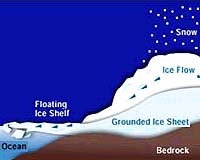
Boulder CO (SPX) Sep 22, 2004 Glaciers in Antarctica's most rapidly warming region have quickened their pace following the collapse of a Delaware-sized ice shelf in March 2002, according to a new study led by the University of Colorado at Boulder and a related study by NASA's Jet Propulsion Laboratory. Landsat 7 satellite images taken before, during and after the break-up of the Larsen B ice shelf in March 2002 show that several of the glaciers are now moving at up to five times their previous speed, said University of Colorado at Boulder researcher Ted Scambos. Other satellite data show that the glaciers also have thinned significantly since the disintegration of the Larsen B, he said. The recent events underscore the potential for sea-level rise as a result of climate warming over the Earth's polar caps. "The Larsen area can be looked at as a miniature experiment, showing how warming can dramatically change the ice sheets, and how fast it can happen," he said. "At every step in the process, things have occurred more rapidly than we expected." Authored by Scambos and Jennifer Bohlander of CU-Boulder's National Snow and Ice Data Center, Christopher Shuman of NASA's Goddard Space Flight Center and Pedro Skvarca of Argentina's Institute of Antarctica, the study will appear online Sept. 22 and will be accessible online. The paper will be published in the Sept. 28 issue of Geophysical Research Letters. The study also included elevation measurements from NASA's Ice Cloud and Land Elevation Satellite, or ICESat. The CU-Boulder study was funded by NASA and the National Science Foundation. A similar study is being simultaneously published in GRL by researchers at NASA's Jet Propulsion Laboratory. Headed by Eric Rignot, the JPL study used radar images and airborne measurements to profile ice thickness in the same region of the Antarctic and showed further glacier acceleration in late 2003 and early 2004, with some glaciers reaching eight times their original speeds. Glaciers showed an almost immediate response after the ice shelf collapse, with some nearly tripling in speed within a matter of months, according to the CU-Boulder study. The Hektoria and Green glaciers, which sped up the most, are currently moving about a mile per year. Most glaciers move much more slowly, from a few inches to several hundred yards annually. The satellite images used in the CU-Boulder study also showed the lower parts of the glaciers fracturing and disintegrating in response to the loss of the ice shelf. Glaciers where the Larsen B ice shelf remains intact have shown little change, Scambos said. The area, located at the far northern tip of the Antarctic just south of Chile and Argentina, has seen a rise in mean annual temperatures of up to 4.5 degrees Fahrenheit in the past 60 years - faster than almost any region in the world. In the past 30 years, ice shelves in the region have decreased by more than 5,200 square miles. "This study shows very clearly that glaciers which flow into ice shelves are partially controlled by the presence of the shelf, which acts as a kind of braking system," Scambos said. "Removing the shelf makes them speed up." The CU study included several elevation profiles from ICESat, which carries a laser altimeter specifically designed to measure changes in Earth's ice sheets. Built by Boulder's Ball Aerospace for NASA, the satellite was launched in 2003 and is being operated at the CU-Boulder Laboratory for Atmospheric and Space Physics. Profiles from ICESat showed that the surfaces of the glaciers had dropped by up to 115 feet at their lower ends, confirming that the acceleration was leading to a large loss of ice from the ice sheet. The glacier profiles were produced by Scambos and Shuman. The study highlights the sensitivity of the poles to climate change, Scambos said. "As temperatures crossed the threshold of melting in the summer months, ice shelves in the area rapidly disintegrated. Not only do the ice shelves collapse rapidly, but the subsequent effects on the glaciers are immediate," he said. In three cases since 1995, large areas in the Antarctic have collapsed suddenly. They include the Larsen A Ice Shelf in 1995 (618 square miles), the Wilkins Ice Shelf in 1998 (425 square miles) and the Larsen B Ice Shelf in 2002 (1,235 square miles). According to Scambos, the recent warming trend in the area has led to greater amounts of melt "ponding" on the ice shelves, weakening and then destroying them. "Meltwater at the surface acts to increase the extent of fracturing in the ice," he said. The weight of the water essentially forces the cracks open, so a relatively small amount of climate warming can destroy large, centuries-old ice shelves. "While the consequences of this area are small compared to other parts of the Antarctic, it is a harbinger of what will happen when the large ice sheets begin to warm," Scambos said. "The much larger ice shelves in other parts of Antarctica could have much greater effects on the rate of sea-level rise." The Ross ice shelf, for example, is the main outlet for the West Antarctic Ice Sheet, which harbors several large glaciers that contain the equivalent of about 16 feet of global sea-level rise. While researchers once thought summertime temperatures in the Ross ice-shelf area were far below freezing and therefore stable, they appear to be just a few degrees below the threshold for surface ponding, Scambos said. Community Email This Article Comment On This Article Related Links University of Colorado at Boulder SpaceDaily Search SpaceDaily Subscribe To SpaceDaily Express Nuclear Space Technology at Space-Travel.com
 Rewriting Glacial History In Pacific North America
 Edmonton AB (SPX) Jan 10, 2006
Although the story on glacier fluctuations in northwestern North America over the last 10,000 years has remained largely unchanged for decades, new evidence discovered by a University of Alberta researcher will rewrite that glacial history and offer clues about our climate history during the last several thousand years. |
|
|

| The content herein, unless otherwise known to be public domain, are Copyright 1995-2006 - SpaceDaily.AFP and UPI Wire Stories are copyright Agence France-Presse and United Press International. ESA PortalReports are copyright European Space Agency. All NASA sourced material is public domain. Additionalcopyrights may apply in whole or part to other bona fide parties. Advertising does not imply endorsement,agreement or approval of any opinions, statements or information provided by SpaceDaily on any Web page published or hosted by SpaceDaily. Privacy Statement |