|
 |
 |
 |
 |
 |
 |
 |
 |

 |
Annan Opens Nuclear Test Ban Meeting, Urges Swift Signing, Ratification
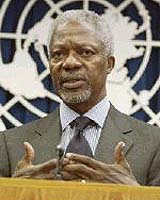
United Nations (AFP) Sep 21, 2005 UN chief Kofi Annan opened a review conference on the nuclear test ban treaty here Wednesday, urging states which have not yet signed or ratified it to do so without delay and lamenting the world's failure to tackle disarmament. "After nine years, the treaty is still not in force. We should all be gravely concerned about that," he told the opening sesion of the fourth conference on facilitating the entry into force of the Comprehensive Nuclear Test Ban Treaty. "The longer entry into force is delayed, the greater the risk that someone somewhere will test nuclear weapons," he warned. "That would be a major setback for the cause of non-proliferation and disarmament." Annan urged swift signing or ratification of the treaty and appealed to all states to maintain a moratorium on nuclear weapons test explosions or any other nuclear blasts and to refrain from acts that would defeat the purpose of the pact. Annan's appeal, backed by several participants, including Britain, Canada, Australia and Kazakhstan, came only a week after a world summit here failed to address the burning issue of disarmament and non-proliferation in a UN reform blueprint which got overhelming approval. The three-day meeting is to review a wide range of major technical issues, including the verification regime and setting up an effective tsunami early warning system. Speaking on behalf of the European Union, British Foreign Secretary Jack Straw deplored the failure of the Non Proliferation Treaty review conference in May, noting that an increasing number of states were within reach of mastering nuclear arms technology. "There is also a growing risk that such weapons of mass destruction will falls into the hands of non-state actors who would not hesitate to use them to kill large numbers of innocent people," he added. Straw also stressed the need for a "fully functioning verification regime" by the time the treaty comes into force. "The European Union is particularly encouraged by the positive steps made in establishing an International Monitoring System which is unprecedented both in its technological scope and its global coverage," he said. He cited the need for a robust on-site inspection regime to deter any would-be testers of nuclear weapons. Straw said another benefit from the treaty's verification system would be to provide data that can benefit the humanitarian consequences of disasters such as last December's tsunami disaster in the Indian Ocean. Kazakhstan, which 10 years ago voluntarily scrapped its nuclear arsenal -- the world's fourth largest -- said it had submitted proposals to host a regional seismic center and an internationl center for training experts from CTBT member states, its foreign minister, Kassymzhomart Tokaev, said. Meanwhile Canadian Foreign Minister Pierre Pettigrew said his country had proposed to prod states in the same region to ratify the pact in a coordinated manner. "Building confidence is often a leap of faith: by ratifying the CTBT simultaneously, states can make a significant leap jointly for the benefit of the entire world," he added. The treaty, which bans any nuclear blasts for military or civilian purposes, was signed in 1996 by 71 states, including the five main nuclear powers, and now has 176 member states. The treaty has not yet been ratified by the required 44 states which had nuclear research or power facilities when it was adopted for it to take effect, rendering it powerless. But only 33 have done so, the United States has so far failed to ratify the text, while three key countries -- India, Pakistan and North Korea -- have not even signed it. Both India and Pakistan have carried out nuclear tests since 1996, while North Korea has threatened to do so. The previous review conference was held in Vienna -- where the CTBT organization is based -- in 2003. Community Email This Article Comment On This Article Related Links SpaceDaily Search SpaceDaily Subscribe To SpaceDaily Express Learn about nuclear weapons doctrine and defense at SpaceWar.com Learn about missile defense at SpaceWar.com All about missiles at SpaceWar.com Learn about the Superpowers of the 21st Century at SpaceWar.com
 World Powers Threaten Defiant Iran Over Nuclear Crisis
 Vienna (AFP) Jan 11, 2006
World powers threatened Iran with UN Security Council sanctions Wednesday after it resumed sensitive nuclear activities as a defiant Tehran vowed to press ahead with its disputed atomic programme. |
|
|

| The content herein, unless otherwise known to be public domain, are Copyright 1995-2006 - SpaceDaily.AFP and UPI Wire Stories are copyright Agence France-Presse and United Press International. ESA PortalReports are copyright European Space Agency. All NASA sourced material is public domain. Additionalcopyrights may apply in whole or part to other bona fide parties. Advertising does not imply endorsement,agreement or approval of any opinions, statements or information provided by SpaceDaily on any Web page published or hosted by SpaceDaily. Privacy Statement |