
 |
 |
 |
 |
 |
 |
 |
 |
 |

 |
Ancient Mineral Shows Early Earth Climate Tough On Continents
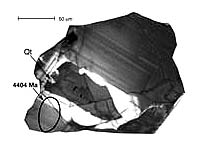
Madison WI (SPX) Jun 19, 2008 A new analysis of ancient minerals called zircons suggests that a harsh climate may have scoured and possibly even destroyed the surface of the Earth's earliest continents. Zircons, the oldest known materials on Earth, offer a window in time back as far as 4.4 billion years ago, when the planet was a mere 150 million years old. Because these crystals are exceptionally resistant to chemical changes, they have become the gold standard for determining the age of ancient rocks, says University of Wisconsin-Madison geologist John Valley. Valley previously used these tiny mineral grains - smaller than a speck of sand - to show that rocky continents and liquid water formed on the Earth much earlier than previously thought, about 4.2 billion years ago. In a new paper published online this week in the journal Earth and Planetary Science Letters, a team of scientists led by UW-Madison geologists Takayuki Ushikubo, Valley and Noriko Kita show that rocky continents and liquid water existed at least 4.3 billion years ago and were subjected to heavy weathering by an acrid climate. Ushikubo, the first author on the new study, says that atmospheric weathering could provide an answer to a long-standing question in geology: why no rock samples have ever been found dating back to the first 500 million years after the Earth formed. "Currently, no rocks remain from before about 4 billion years ago," he says. "Some people consider this as evidence for very high temperature conditions on the ancient Earth." Previous explanations for the missing rocks have included destruction by barrages of meteorites and the possibility that the early Earth was a red-hot sea of magma in which rocks could not form. The current analysis suggests a different scenario. Ushikubo and colleagues used a sophisticated new instrument called an ion microprobe to analyze isotope ratios of the element lithium in zircons from the Jack Hills in western Australia. By comparing these chemical fingerprints to lithium compositions in zircons from continental crust and primitive rocks similar to the Earth's mantle, they found evidence that the young planet already had the beginnings of continents, relatively cool temperatures and liquid water by the time the Australian zircons formed. "At 4.3 billion years ago, the Earth already had habitable conditions," Ushikubo says. The zircons' lithium signatures also hold signs of rock exposure on the Earth's surface and breakdown by weather and water, identified by low levels of a heavy lithium isotope. "Weathering can occur at the surface on continental crust or at the bottom of the ocean, but the [observed] lithium compositions can only be formed from continental crust," says Ushikubo. The findings suggest that extensive weathering may have destroyed the Earth's earliest rocks, he says. "Extensive weathering earlier than 4 billion years ago actually makes a lot of sense," says Valley. "People have suspected this, but there's never been any direct evidence." Carbon dioxide in the atmosphere can combine with water to form carbonic acid, which falls as acid rain. The early Earth's atmosphere is believed to have contained extremely high levels of carbon dioxide - maybe 10,000 times as much as today. "At [those levels], you would have had vicious acid rain and intense greenhouse [effects]. That is a condition that will dissolve rocks," Valley says. "If granites were on the surface of the Earth, they would have been destroyed almost immediately - geologically speaking - and the only remnants that we could recognize as ancient would be these zircons." Community Email This Article Comment On This Article Share This Article With Planet Earth
Related Links University of Wisconsin-Madison Explore The Early Earth at TerraDaily.com
 Ebb And Flow Of The Sea Drives Big Extinction Events
 Madison WI (SPX) Jun 17, 2008
If you are curious about Earth's periodic mass extinction events such as the sudden demise of the dinosaurs 65 million years ago, you might consider crashing asteroids and sky-darkening super volcanoes as culprits. |
|
|

| The content herein, unless otherwise known to be public domain, are Copyright 1995-2007 - SpaceDaily.AFP and UPI Wire Stories are copyright Agence France-Presse and United Press International. ESA Portal Reports are copyright European Space Agency. All NASA sourced material is public domain. Additional copyrights may apply in whole or part to other bona fide parties. Advertising does not imply endorsement,agreement or approval of any opinions, statements or information provided by SpaceDaily on any Web page published or hosted by SpaceDaily. Privacy Statement |
 del.icio.us
 Digg
Digg Reddit
 YahooMyWeb
 Google
 Facebook