
 |
 |
 |
 |
 |
 |
 |
 |
 |

 |
Ancient Escape Hatches
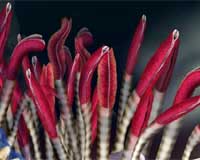
Moffett Field CA (SPX) Feb 17, 2009 Tubeworms have been around for millions of years and the fossil record is rich with their distinctive imprints. But a discovery made by University of Calgary scientists found that what previous researchers had labeled as tubeworms in a formation near Denver, Colorado, are actually 70 million-year-old escape hatches for methane. Tubeworms, or siboglinids, look like long lipstick tubes and have been observed in warm and cold environments on the ocean floor, as well as in whale carcasses and decomposing organic-rich cargoes in sunken ships. Ecosystems teeming with tubeworm colonies were discovered at hydrothermal vents in the Galapagos Ridge in 1977 and at cold seeps at the base of the Florida Escarpment in 1984. As a result of these modern sightings, a number of fossil examples of tubeworms were subsequently identified in the rock record. One of these localities, found south of Denver, Colorado, was recently re-examined by U of C scientists. In an area approximately one and a half times the size of the City of Calgary, scientists discovered that what was previously identified as fossilized tubeworms were actually fossilized tubular escape hatches for methane, a major constituent of natural gas. "It is the first time that evidence of a natural ancient geologic conduit system has been discovered where gas, water and solids were all being vented at once," says Federico Krause, the lead author of the paper which is co-authored by Selim Sayegh, an adjunct professor in geoscience, Jesse Clark, a former undergraduate student, and Renee Perez, research associate in the Department of Chemical and Petroleum Engineering. The paper is published in this month's edition of Palaios. The discovery was made possible thanks to the Stable Isotope Laboratory of the Department of Physics and Astronomy and the electronic microprobe housed in the Department of Geoscience. Stable isotopes and chemical elements maps demonstrated that not only methane gas bubbles were being expelled but that solid particles that had adhered to the bubbles were also being ejected from the fossil vents. Although the results may be surprising, the ramifications are even more so. The fact that methane gas can escape from a thick shale seafloor may demonstrate that there needs to be more research done on the integrity of geologic seals in petroleum reservoirs earmarked for CO2 injection," says Krause who is a professor in the Department of Geoscience at the University of Calgary. "It shows that under different geologic circumstances gases that are present in underground formations can indeed seep out, and all the effort expended in trying to remove CO2 from our atmosphere would be lost." In addition, there are vast volumes of methane gas naturally trapped beneath the seafloor in the form of gas hydrates. If these hydrates were to be destabilized, methane bubbles could release large quantities of microparticles to the ocean bottom. This release would cloud up the deep ocean and the effect would be akin to fouling up the atmosphere with a dense smog. Given that the ocean bottom is one of the last frontiers of petroleum exploration, further research will be needed to properly plan for the location of production and containment facilities on the seafloor. Installation of these facilities has the potential to destabilize underlying hydrates. "These 70-million-year-old tubular escape hatches south of Denver, Colorado, provide a glimpse to processes that are occurring in the ocean bottoms at present," says Krause. "While finding tubeworms would have been satisfying, uncovering tubular gas vents has been much more exciting." Share This Article With Planet Earth
Related Links BioOne University of Calgary Darwin Today At TerraDaily.com
 Mix And Match Genes
 Moffett Field CA (SPX) Feb 17, 2009
All life - plants, animals, people - depends on peaceful coexistence with a swarm of microbial life that performs vital services from helping to convert food to energy to protection from disease. |
|
|

| The content herein, unless otherwise known to be public domain, are Copyright 1995-2007 - SpaceDaily.AFP and UPI Wire Stories are copyright Agence France-Presse and United Press International. ESA Portal Reports are copyright European Space Agency. All NASA sourced material is public domain. Additional copyrights may apply in whole or part to other bona fide parties. Advertising does not imply endorsement,agreement or approval of any opinions, statements or information provided by SpaceDaily on any Web page published or hosted by SpaceDaily. Privacy Statement |
 del.icio.us
 Digg
Digg Reddit
 YahooMyWeb
 Google
 Facebook