|
 |
 |
 |
 |
 |
 |
 |
 |

 |
Analysis: Korean Peace, Long Way To Go
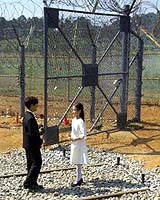
Seoul (UPI) June 15, 2005 Five years ago, the divided Korean peninsula was swept by an unprecedented wave of reconciliation and reunification euphoria. Leaders from the two rival Koreas met in June 2002 for the first time in five decades and signed a historic agreement that called for reconciliation, cooperation and eventual reunification. Under the June 15 summit declaration, they took a series of steps toward ending their Cold War hostility, highlighted by the reconnection of cross-border roads and railways across the heavily armed border, and joint industry and tourism projects. Emotional reunions by separated families forced to live apart by the 1945 division further deepened aspirations for reunification. The reconciliation fever, however, has been cooled in the wake of the nuclear crisis that has haunted the peninsula for the past three years. Tensions are again running high after North Korea's declaration of nuclear weapons possession and U.S. warnings of possible sanctions. Former South Korean President Kim Dae-jung, who won the 2000 Nobel Peace Prize for starting the inter-Korean summit, lost much of his sheen as he was accused of secretly transferring $500 million to North Korea in an alleged bid to stage the summit. North Korean leader Kim Jong Il has yet to carry out his promise to make a return visit to Seoul for a second summit and has been defiant in the face of international calls for the resumption of international disarmament talks that involve China, Japan, the two Koreas, Russia and the United States. The North has refused to have defense ministers' talks with the South, which are necessary to reduce military tensions. Hundreds of representatives from North and South Korea gathered in Pyongyang Wednesday to celebrate the fifth anniversary of the Korean summit, but the meeting was largely overshadowed by the nuclear issue. South Korean delegates hope to use the joint event to persuade Pyongyang to return to talks, whereas North Koreans called on the South to forge a united Korean front against the United States in the standoff. North Korea agreed to conduct the event only after Seoul agreed to its demand to reduce the size of its delegation, which Pyongyang said was needed because of pressure from Washington, citing higher pressure and criticism from South Korea's ally, the United States, referring its decision to temporarily deploy 15 F-117A Nighthawk stealth bombers to South Korea. The cooling toward reconciliation in the South was evinced by a recent public survey. According to Seoul's polling agency TNS and SBS-TV, 67.6 percent of South Koreans said they consider inter-Korean relations since the summit "unsuccessful," a sharp increase from 14.9 percent in August 2000. Those who said inter-Korean ties were successful decreased to 29.9 percent this week from 82.7 percent five years ago, the survey showed. Many analysts still hail the 2000 summit as a great move toward peace and stability on the peninsula, but add an early resolution of the nuclear crisis is critical to further reconciliation. "For the past five years since the summit, the inter-Korean ties have enhanced to a level beyond imagination and the two Koreas are so interlocked with each other," Jeong Se-hyun, who served as Seoul's unification minister, said in a recent forum. "North Korea's economic dependence on South Korea is now so deep that it cannot reverse the course," said Park Young-ho, a North Korea expert at the state-run Korea Institute for National Unification. Inter-Korean trade has sharply increased to $690 million from $330 million in 1999, making the South the second-largest trading partner with the North after China, according the Unification Ministry. Since the 2000 summit, the two Koreas have 124 meetings, or 24 meetings a year, including 14 rounds of Cabinet-level talks. The 15th round is scheduled for June 21-24 in Seoul. Currently, 2,300 North Koreans and 500 from the South work together at their joint industrial complex in a North Korean border city of Kaesong. North Korean-made clothes and kitchenware products are sold in stores in South Korea. Since opening in November 1998, North Korea's Mount Kumgang resort has attracted more than 1 million tourists from the South. The resort attracted a record 272,820 South Koreans in 2004, compared to 3,317 in 1998 and 7,280 in 2000. "Cross-border economic and personnel exchanges played a positive role in improving inter-Korean ties," said Dong Yong-seung, head of the North Korea team at the Samsung Economic Research Institute in Seoul. "But the nuclear issue is hindering further improvements. Without the resolution of the nuclear standoff, inter-Korean cooperation process remains fragile." Community Email This Article Comment On This Article Related Links SpaceDaily Search SpaceDaily Subscribe To SpaceDaily Express Learn about nuclear weapons doctrine and defense at SpaceWar.com Learn about missile defense at SpaceWar.com All about missiles at SpaceWar.com Learn about the Superpowers of the 21st Century at SpaceWar.com
 World Powers Threaten Defiant Iran Over Nuclear Crisis
 Vienna (AFP) Jan 11, 2006
World powers threatened Iran with UN Security Council sanctions Wednesday after it resumed sensitive nuclear activities as a defiant Tehran vowed to press ahead with its disputed atomic programme. |
|
|

| The content herein, unless otherwise known to be public domain, are Copyright 1995-2006 - SpaceDaily.AFP and UPI Wire Stories are copyright Agence France-Presse and United Press International. ESA PortalReports are copyright European Space Agency. All NASA sourced material is public domain. Additionalcopyrights may apply in whole or part to other bona fide parties. Advertising does not imply endorsement,agreement or approval of any opinions, statements or information provided by SpaceDaily on any Web page published or hosted by SpaceDaily. Privacy Statement |