|
 |
 |
 |
 |
 |
 |
 |
 |

 |
A Warm Polar Winter Was Easier On Arctic Ozone
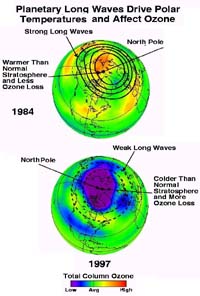
Greenbelt - Jun 03, 2002 A NASA researcher has found unusually high levels of protective upper atmospheric ozone in the Arctic as a result of a rare sudden warming during the early winter of 1998. "There are several factors that control polar ozone including air temperature in the stratosphere, the presence of polar stratospheric clouds (PSCs), and the timing and strength of large atmospheric waves that bring ozone to the poles from the tropics," said Susan Strahan, an atmospheric scientist at NASA's Goddard Space Flight Center, Greenbelt, Md., and author of a paper being presented at the American Geophysical Union's spring meeting in Washington. During the wintertime, as the temperatures drop, winds swirl around the poles and form a vortex. The atmospheric circulation brings ozone from the upper to the lower stratosphere, where temperatures are colder. The stronger the vortex, the less ozone is transported to the cold lower stratosphere, where breakdown of ozone by PSCs can occur. During 1998, however, Strahan found that more low latitude air surged poleward in December of that year bringing higher levels of ozone than usual and warmer than normal temperatures into the Arctic vortex. From January to March, the high ozone air descended to lower altitudes in the vortex, where polar stratospheric clouds often form. These clouds form during colder temperatures and cause ozone molecules to break apart, but the warm air that surged with the ozone prevented the PSCs from forming. "As a result, ozone in the lower stratospheric vortex was higher than usual this year because more ozone than usual was transported into it," Strahan said. Strahan's research is supported by earlier findings by NASA's Paul Newman in 2001 that said large-scale atmospheric waves carry ozone from the equator to the poles. Typically, ozone "piles up" in the stratosphere over the tropics. When the large-scale waves are stronger and occur more often than usual, they push more low latitude air northward, bringing high ozone and warmer temperatures with them to the poles. According to Newman, "In cold years like 1997, weaker, and less frequent waves reduced the effectiveness of the Arctic heat engine and cooled the stratosphere, making conditions just right for ozone destruction." Strahan explained that in a cold year, with weaker waves, polar ozone levels get a "double whammy," because less ozone gets transported to the poles from the tropics because temperatures are lower, allowing more PSCs form, which leads to more ozone loss. Strahan said that it is important to keep in mind that even without ozone loss by PSCs, the amount of ozone in the Arctic stratosphere varies from year to year depending on the strength of the large- scale waves and the quantity of ozone they bring. Further, she stressed that ozone loss by chlorine is controlled by temperature and only indirectly by the variability in the large-scale waves. If the wave activity is strong enough to raise the vortex above temperatures where the PSCs can form throughout the winter, then the wave activity can prevent ozone loss. She said that December 1999 had little wave activity, allowing the Arctic vortex to become large and strong by the beginning of winter. This restricted the transport of ozone to the polar region, while at the same time, the low vortex temperatures allowed a significant amount of PSCs to form and more ozone loss to occur during the winter of 1999 to 2000. Community Email This Article Comment On This Article Related Links SpaceDaily Search SpaceDaily Subscribe To SpaceDaily Express Dirt, rocks and all the stuff we stand on firmly
 Environmental Damage Threatens Human Health
 Bangkok (AFP) Dec 9, 2005
Environmental damage threatens human health and may have contributed to the spread of new diseases like bird flu and SARS, the World Health Organization said in a report Friday. |
|
|

| The content herein, unless otherwise known to be public domain, are Copyright 1995-2006 - SpaceDaily.AFP and UPI Wire Stories are copyright Agence France-Presse and United Press International. ESA PortalReports are copyright European Space Agency. All NASA sourced material is public domain. Additionalcopyrights may apply in whole or part to other bona fide parties. Advertising does not imply endorsement,agreement or approval of any opinions, statements or information provided by SpaceDaily on any Web page published or hosted by SpaceDaily. Privacy Statement |