|
 |
 |
 |
 |
 |
 |
 |
 |

 |
A 'Smart' Bio-Nanotube
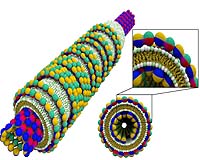
Santa Barbara CA (SPX) Aug 10, 2005 By combining one natural component of a cell with the synthetic analog of another component, researchers at the University of California, Santa Barbara, have created a nanoscale hybrid they call the "smart bio-nanotube": a novel structure that could one day become a vehicle for ultra-precise drug or therapeutic gene delivery. The nanotubes are "smart" because they can open or close at the ends, depending on how the researchers manipulate the electric charge on the two components. So in principle, a nanotube could encapsulate a drug or a gene, and then open on command to deliver the cargo where it would have the best effect. The tube's components play roles similar to skin and bone. The "skin" is a soap-bubble-like arrangement of molecules known as a lipid bilayer, akin to the bilayer that forms the cell's protective outer membrane. The "bone" is a hollow, cylindrical structure known as a microtubule, which is ubiquitous in the cell's internal cytoskeleton, the system of nanoscale struts and girders it uses for internal transport, structural stability and many other purposes. The researchers have found that when they combine the two components and control the conditions properly, open or closed bio-nanotubes will assemble themselves spontaneously. The discovery resulted from a collaboration between the laboratories of UCSB materials scientist Cyrus R. Safinya, and UCSB biochemist Leslie Wilson. Their work was funded by the National Science Foundation's biomaterials program and is reported in the Aug. 9 issue of The Proceedings of the National Academy of Sciences. The report also appeared on-line in the PNAS Early Edition. Community Email This Article Comment On This Article Related Links University of California, Santa Barbara SpaceDaily Search SpaceDaily Subscribe To SpaceDaily Express Nano Technology News From SpaceMart.com Computer Chip Architecture, Technology and Manufacture
 Prof Develops Cancer Nanobomb
 Newark DE (SPX) Oct 14, 2005
University of Delaware researchers are opening a new front in the war on cancer, bringing to bear new nanotechnologies for cancer detection and treatment and introducing a unique nanobomb that can literally blow up breast cancer tumors. |
|
|

| The content herein, unless otherwise known to be public domain, are Copyright 1995-2006 - SpaceDaily.AFP and UPI Wire Stories are copyright Agence France-Presse and United Press International. ESA PortalReports are copyright European Space Agency. All NASA sourced material is public domain. Additionalcopyrights may apply in whole or part to other bona fide parties. Advertising does not imply endorsement,agreement or approval of any opinions, statements or information provided by SpaceDaily on any Web page published or hosted by SpaceDaily. Privacy Statement |