ENERGY TECH
Feather light metal cathodes for stable lithium-oxygen batteries
by Staff Writers
Washington DC (SPX) May 25, 2017


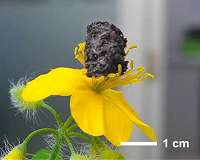
Nanoporous nickel cathodes for lithium oxygen batteries are ultralight, shown here balanced on flower stamens. Credit American Chemical Society

Lithium-oxygen systems could someday outperform today's lithium-ion batteries because of their potential for high energy density. However, a number of important issues, such as their poor electrochemical stability must be addressed before these systems can successfully compete with current rechargeable batteries. Today, in ACS Central Science, researchers report a new type of cathode, which could make lithium-oxygen batteries a practical option.

Xin-Bo Zhang and colleagues note that most of the problems associated with lithium-oxygen battery systems arise from two highly reduced oxygen species that react readily with the electrolyte and the cathode. Carbon is a common strong-performing cathode, but it is unstable in these systems.

So, the team hypothesized that the key to unlocking lithium-oxygen batteries' potential could be to create cathodes that are unreactive to the reduced oxygen species, but that still have the same highly conductive, low-weight, porous characteristics of carbon cathodes. The researchers succeeded in creating an ultralight all-metal cathode.

The design incorporated three forms of nickel including a nanoporous nickel interior and a gold-nickel alloy surface directly attached to nickel foam. Compared to carbon cathodes, the system has much higher capacity and is stable for 286 cycles, which is amongst the best for lithium-oxygen systems, and is nearly competitive with current commercial lithium-ion systems.

Further experimentation showed that the stability and performance arise from both the metal used and its nanoporous structure, and that both these aspects could be optimized to further improve performance.

Research paper

ENERGY TECH
Advancing next-generation Stable, safe, smart, sustainable batteries
Beijing, China (SPX) May 22, 2017
Next-generation rechargeable batteries are promising candidates for state-of-the-art lithium-ion batteries owing to their high energy density and preferred cost efficiency. For instance, Lithium-sulfur batteries, which are featured by their theoretically 10 times higher capacity and 5 times higher energy density, are reviving in both the academic and the industry. Shu Lei Chou and colleagues fro ... read more

Related Links
American Chemical Society
Powering The World in the 21st Century at Energy-Daily.com

Comment using your Disqus, Facebook, Google or Twitter login.

Share this article via these popular social media networks
del.icio.usdel.icio.us DiggDigg RedditReddit GoogleGoogle

ENERGY TECH
China further opens energy sector to private investment

Australia power grid leased to local-foreign consortium

Poland central to EU energy diversification strategy

Myanmar recovery linked to development of electrical grid

ENERGY TECH
Feather light metal cathodes for stable lithium-oxygen batteries

Advancing next-generation Stable, safe, smart, sustainable batteries

Photocatalyst makes hydrogen production 10 times more efficient

Physicists discover that lithium oxide on tokamak walls can improve plasma performance

ENERGY TECH
Scientists track porpoises to assess impact of offshore wind farms

Dutch open 'world's largest offshore' wind farm

OX2 will manage a 45 MW wind farm owned by IKEA Group in Lithuania

Building Energy celebrates the beginning of operations and electricity generation of its first wind farm

ENERGY TECH
NRL Tests Autonomous 'Soaring with Solar' Concept

EU SmartFlex project finishes reference solar facade

InnoEnergy-backed Solaris Offgrid raises 1M Euro to tackle global electricity poverty

Beaumont Solar Announces the Beaumont "Big C" Services Unit to Solar Industry

ENERGY TECH
Swiss vote for gradual nuclear phaseout, energy makeover

Hungary: AREVA NP awarded contract for safety IC modernization at Paks Nuclear Power Plant

India to build 10 domestic nuclear power reactors

Japan restarts another reactor

ENERGY TECH
A full life cycle assessment of second-generation biofuels

Triple play boosting value of renewable fuel could tip market in favor of biomass

Insight into enzyme's 3-D structure could cut biofuel costs

Microbial fuel cell converts methane to electricity

ENERGY TECH
New North Sea production to start in June

Russian oil company reports higher production

Rally in oil prices stumbles ahead of pivotal OPEC meeting

British petrochemicals company INEOS expands oil and gas holdings

ENERGY TECH
The forces that affect species' movements in a changing climate

Merkel vows to convince climate change 'doubters'

Fossil beetles suggest that LA climate has been relatively stable for 50,000 years

Cape Town region declares drought disaster