Scientists are working to dramatically speed up the development of fusion energy in an effort to deliver power to the electric grid soon enough to help mitigate impacts of climate change. The arrival of a breakthrough technology – high-temperature superconductors, which can be used to build magnets that produce stronger magnetic fields than previously possible – could help them achieve this goal.
Researchers plan to use this technology to build magnets at the scale required for fusion, followed by construction of what would be the world's first fusion experiment to yield a net energy gain.
The effort is a collaboration between Massachusetts Institute of Technology's Plasma Science and Fusion Center and Commonwealth Fusion Systems, and they will present their work at the American Physical Society Division of Plasma Physics meeting in Portland, Ore.
Fusion power is generated when nuclei of small atoms combine into larger ones in a process that releases enormous amounts of energy. These nuclei, typically heavier cousins of hydrogen called deuterium and tritium, are positively charged and so feel strong repulsion that can only be overcome at temperatures of hundreds of millions of degrees. While these temperatures, and thus fusion reactions, can be produced in modern fusion experiments, the conditions required for a net energy gain have not yet been achieved.
One potential solution to this could be increasing the strength of the magnets. Magnetic fields in fusion devices serve to keep these hot ionized gases, called plasmas, isolated and insulated from ordinary matter. The quality of this insulation gets more effective as the field gets stronger, meaning that one needs less space to keep the plasma hot.
Doubling the magnetic field in a fusion device allows one to reduce its volume – a good indicator of how much the device costs – by a factor of eight, while achieving the same performance. Thus, stronger magnetic fields make fusion smaller, faster and cheaper.
A breakthrough in superconductor technology could allow fusion power plants to come to fruition. Superconductors are materials that allow currents to pass through them without losing energy, but to do so they must be very cold. New superconducting compounds, however, can operate at much higher temperatures than conventional superconductors. Critical for fusion, these superconductors function even when placed in very strong magnetic fields.
While originally in a form not useful for building magnets, researchers have now found ways to manufacture high-temperature superconductors in the form of "tapes" or "ribbons" that make magnets with unprecedented performance. The design of these magnets is not suited for fusion machines because they are much too small. Before the new fusion device, called SPARC, can be built, the new superconductors must be incorporated into the kind of large, strong magnets needed for fusion.
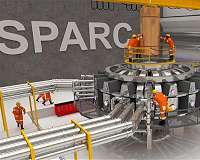
Once the magnet development is successful, the next step will be to construct and operate the SPARC fusion experiment. SPARC will be a tokamak fusion device, a type of magnetic confinement configuration similar to many machines already in operation (Figure 1).
As an accomplishment analogous to the Wright brothers' first flight at Kitty Hawk, demonstrating a net energy gain, the aim of fusion research for more than 60 years, could be enough to put fusion firmly into national energy plans and launch commercial development. The goal is to have SPARC operational by 2025.