
ENERGY TECH
Weak hydrogen bonds key to strong, tough infrastructure
by Staff Writers
Houston TX (SPX) Feb 05, 2018

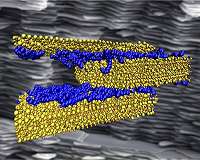
Rice University scientists probing the interfacial interactions of polymer (blue) and cement (yellow) discovered the right mix of hydrogen bonds is critical to making strong, tough and ductile composite materials for infrastructure. Computer simulations like that in the illustration measured the strength of the bonds as hard cement slides past the soft polymer in a layered composite, which mimics the structure nacre, seen in the background. Image courtesy Probhas Hundi/Multiscale Materials Laboratory.

The right mix of hydrogen bonds in polymer and cement composites is critical to making strong, tough and ductile infrastructure material, according to Rice University scientists who want to mimic the mechanics of mother-of-pearl and similar natural composites with synthetic materials.

Seashells made of mother-of-pearl, aka nacre, get their remarkable properties from overlapping micron-sized, mineralized plates held together by a soft matrix. This structure can be approached by cement and polymer composites that may, for instance, make better earthquake-resistant concrete, according to Rouzbeh Shahsavari, an assistant professor of civil and environmental engineering.

The Rice lab ran more than 20 computer simulations of how polymers and cement molecules come together at the nanoscale and what drives their adhesion. The researchers showed that the proximity of oxygen and hydrogen atoms is the critical factor in forming a network of weak hydrogen bonds that connects soft and hard layers. Common polyacrylic acid (PAA) proved best at binding the overlapping layers of cement crystals with an optimal overlap of about 15 nanometers.

"This information is important to make the best synthetic composites," said Shahsavari, who ran the project with Rice graduate student Navid Sakhavand.

"A modern engineering approach to these materials will have a large impact on society, especially as we build new and replace aging infrastructure."

While engineers understand that adding polymers improves cement by blocking the damaging effects of "aggressive" ions that invade its pores, details about how the materials interact at the molecular scale have remained unknown, Shahsavari said. To find out, the researchers modeled composites with PAA as well as polyvinyl alcohol (PVA), both soft matrix materials that have been used to improve cement.

They discovered that the two different oxygen atoms in PAA (as opposed to one in PVA) allowed it to receive and donate ions as it bonded with hydrogen in the crystals of tobermorite cement. Oxygen in PAA had eight ways to bond with hydrogen (six for PVA) and could also participate in salt bridging between the polymer and cement, which makes the bonding network even more complex.

The researchers tested their simulated structures by sliding layers of polymer and cement against each other and found that complexity allowed the bonds between PAA and cement to break and reconnect more frequently as the material was stressed, which significantly increases its toughness, the ability to deform without fracturing. This allowed the researchers to determine the optimum overlap between cement crystals.

"In contrast to the common intuition that hydrogen bonds are weak, when the right number of them - the optimum overlap - cooperate, they provide sufficient connectivity in the composite to confer high strength and high toughness," Shahsavari said.

"From an experimental standpoint, this can be done by carefully tuning and controlling the addition of the polymers with the right molecular weight while controlling cement mineral formation. Indeed, a recent experimental paper by our colleagues showed a proof of concept toward this strategy."

Research paper


Related Links
Rice University
Powering The World in the 21st Century at Energy-Daily.com

ENERGY TECH
20 percent more trees in megacities would mean cleaner air and water, lower carbon and energy use
New York NY (SPX) Feb 01, 2018
Planting 20 percent more trees in our megacities would double the benefits of urban forests, like pollution reduction, carbon sequestration and energy reduction, according to a study in Ecological Modelling. The authors of the study, which was carried out at Parthenope University of Naples in Italy, say city planners, residents and other stakeholders should start looking within cities for natural resources and conserve the nature in our urban areas by planting more trees. Their work has been selected by ... read more

Comment using your Disqus, Facebook, Google or Twitter login.

Share this article via these popular social media networks
del.icio.usdel.icio.us DiggDigg RedditReddit GoogleGoogle

ENERGY TECH
State utilities called to pass U.S. tax benefits to consumers

Magnetic liquids improve energy efficiency of buildings

US energy watchdog rejects plan to subsidize coal, nuclear sectors

U.S. utility regulator ponders grid reliability

ENERGY TECH
Making fuel cells for a fraction of the cost

Coupling experiments to theory to build a better battery

20 percent more trees in megacities would mean cleaner air and water, lower carbon and energy use

Graphene girders doubles life of lithium batteries

ENERGY TECH
Ireland pushing for greener economy

China wind turbine-maker guilty of stealing US trade secrets

Scotland sets up $83 million low-carbon fund

German offshore wind farm closer to powering mainland

ENERGY TECH
Kyocera TCL Solar completes 21MW solar plant on repurposed land

New discovery could improve organic solar cell performance

Less than half of EU members meet 2020 renewable targets

Solar PV cost reductions will offset impact of new tariffs on panel prices

ENERGY TECH
Thorium reactors may dispose of enormous amounts of weapons-grade plutonium

Framatome continues ramping up production at its Le Creusot site

USA: Framatome to acquire Instrumentation and Control nuclear business of Schneider Electric

Framatome nuclear fuel contract with CNNC

ENERGY TECH
Bio-renewable process could help 'green' plastic

To maximize sugarcane harvesting, use the right blade

The making of biorelevant nanomaterials

Malaysia protest against EU push to ban palm oil in biofuels

ENERGY TECH
Method of petroleum extraction based on injections of nanosized metal oxide colloids

Royal Dutch Shell sees big profits, but lower cash flow

Dutch farmers protest fracking as govt set to cut gas output

Offshore Asia-Pacific not prepared for decommissioning

ENERGY TECH
NETs will not compensate for inadequate climate change mitigation efforts: EASAC report

France says it fell short on greenhouse gas emissions

How to reduce heat extremes by 3C

Latin Americans more concerned about climate change than US, Canada