The U.S. scientific community is currently conceptualizing the first nuclear fusion power plants, which will revolutionize energy production. Like the sun and stars, a fusion power plant will produce energy by fusing light elements, like hydrogen, into heavier ones, like helium, at temperatures higher than 25 million F. Fusing hydrogen to produce helium releases about 4 million times more energy than a chemical reaction, such as the burning of coal, oil, or gas.
Yet, the fusion reaction neither releases carbon dioxide in the atmosphere, nor results in radioactive biproducts, which makes it one of the most promising ways to produce clean energy on Earth.
At such high temperatures, atoms decompose into positively charged nuclei (or ions) and negatively charged electrons, creating a state of matter called plasma. In the donut-shaped fusion device, called a tokamak, the plasma is held inside the vessel with the help of strong magnetic fields that can control the paths of the charged particles. Efficiently generating fusion energy requires containing the plasma long enough for the ions to collide and fuse.
These plasmas, however, can harbor electromagnetic oscillations, known as Alfven waves, which cause the magnetic fields to vibrate much like plucking a guitar string. The vibrations can carry energetic ions out of the hot core region of the plasma before fusion occurs, much like a surfer riding a wave.
Studying and controlling this fast ion flow in a fusion reactor require an understanding of the paths these ions travel and where they end up. The individual migration trajectories of the ions have been a long-standing, unresolved mystery-until now.
Recently, scientists at the DIII-D National Fusion Facility in San Diego developed a new instrument, called the imaging neutral particle analyzer, that works as follows. First, a beam of neutral (uncharged) particles is injected in the core of the plasma, where the fast ion flow occurs. When an injected neutral particle collides with a fast ion from the core, the two particles exchange electrons.
In this charge-exchange process, the fast ions accept electrons and turn into fast neutrals. These fast neutrals can escape the core plasma because their lack of charge means they are not trapped by the magnetic fields. As they escape, they are captured by the imaging neutral particle analyzer, which can reconstruct information about the energy, trajectory and orientation of the original fast ions.
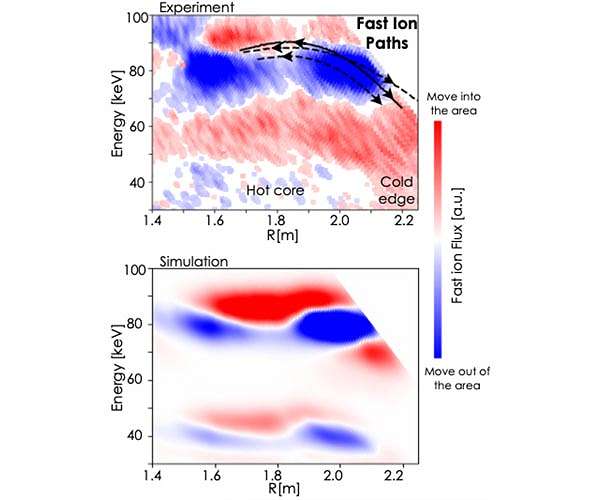
Combining this information, the instrument has for the first time revealed details about the fast ion flow driven by the Alfven waves. Researchers observed that some ions moved toward the colder external regions of the plasma, while others surprisingly gained energy from the Alfven waves and traveled towards the hotter plasma core regions (Figure 1).
Like birds, this particle migration occurs along specific routes, and as with birds, the routes are determined by the environment the particles move through, specifically the wave frequency, wave number, and other factors associated with particle motion. These routes, which are induced by multiple waves, also intersect with each other.
That suggests the possibility that fast ions experience a large-scale migration by transitioning among different routes, and some ions follow routes that allow them to escape the core, while others return to it. The observed migration paths were also confirmed by state-of-the-art plasma simulations.
It is important to note that a strong fast ion flow is destructive to the operation of fusion plasmas, because if the particles exit the plasma too quickly to transfer their energy, this will limit the achievable temperatures needed to keep the fusion process going. To reduce this transport, scientists are examining possible ways to reduce migration routes and their intersections, and to remove the "last mile" route for fast ions to escape the plasma.