
ENERGY TECH
Stretchy, washable battery brings wearable devices closer to reality
by Staff Writers
Vancouver, Canada (SPX) Dec 10, 2021

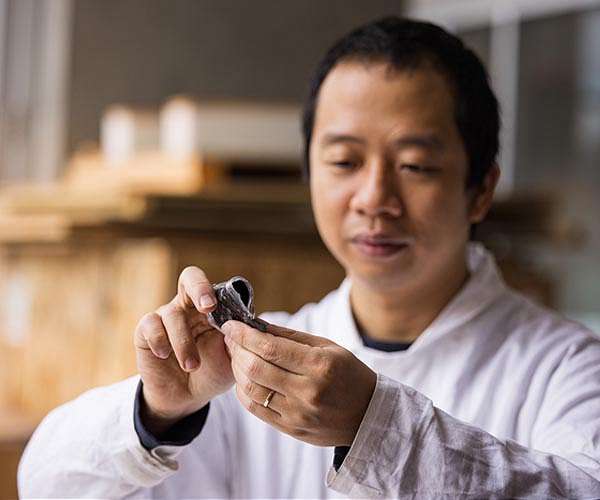
Dr. Ngoc Tan Nguyen and his colleagues have created a battery that is both flexible and washable. It works even when twisted or stretched to twice its normal length, or after being washed multiple times.

UBC researchers have created what could be the first battery that is both flexible and washable. It works even when twisted or stretched to twice its normal length, or after being tossed in the laundry.

"Wearable electronics are a big market and stretchable batteries are essential to their development," says Dr. Ngoc Tan Nguyen (he/him), a postdoctoral fellow at UBC's faculty of applied science. "However, up until now, stretchable batteries have not been washable. This is an essential addition if they are to withstand the demands of everyday use."

The battery developed by Dr. Nguyen and his colleagues offers a number of engineering advances. In normal batteries, the internal layers are hard materials encased in a rigid exterior. The UBC team made the key compounds-in this case, zinc and manganese dioxide-stretchable by grinding them into small pieces and then embedding them in a rubbery plastic, or polymer. The battery comprises several ultra-thin layers of these polymers wrapped inside a casing of the same polymer. This construction creates an airtight, waterproof seal that ensures the integrity of the battery through repeated use.

It was team member Bahar Iranpour (she/her), a PhD student, who suggested throwing the battery in the wash to test its seal. So far, the battery has withstood 39 wash cycles and the team expects to further improve its durability as they continue to develop the technology.

"We put our prototypes through an actual laundry cycle in both home and commercial-grade washing machines. They came out intact and functional and that's how we know this battery is truly resilient," says Iranpour.

The choice of zinc and manganese dioxide chemistry also confers another important advantage. "We went with zinc-manganese because for devices worn next to the skin, it's a safer chemistry than lithium-ion batteries, which can produce toxic compounds when they break," says Nguyen.

An affordable option
Ongoing work is underway to increase the battery's power output and cycle life, but already the innovation has attracted commercial interest. The researchers believe that when the new battery is ready for consumers, it could cost the same as an ordinary rechargeable battery.

"The materials used are incredibly low-cost, so if this is made in large numbers, it will be cheap," says electrical and computer engineering professor Dr. John Madden (he/him), director of UBC's Advanced Materials and Process Engineering Lab who supervised the work. In addition to watches and patches for measuring vital signs, the battery might also be integrated with clothing that can actively change colour or temperature.

"Wearable devices need power. By creating a cell that is soft, stretchable and washable, we are making wearable power comfortable and convenient."

Research Report: "Washable and Stretchable Zn-MnO2 Rechargeable Cell"


Related Links
University of British Columbia
Powering The World in the 21st Century at Energy-Daily.com

ENERGY TECH
'Nobody's dump': Lithium mine stirs unrest in Serbia
Gornje Nedeljice, Serbia (AFP) Dec 10, 2021
Farmhouses and cornfields dot the gentle, rolling plains of Serbia's Jadar Valley, but underneath the bucolic surface lies one of Europe's largest lithium deposits - the source fuelling the latest round of unrest in the Balkan nation. The future of the vast mineral deposits near the city of Loznica has become the latest flashpoint in Serbia, pitting festering distrust in the country's increasingly autocratic government against Europe's plans for a greener future. Billions are at stake with Ang ... read more

Comment using your Disqus, Facebook, Google or Twitter login.

Share this article via these popular social media networks
del.icio.usdel.icio.us DiggDigg RedditReddit GoogleGoogle

ENERGY TECH
Wildlife concerns blunt Germany's green power efforts

Biden calls for carbon neutral federal government by 2050

30,000 UK homes still without power after storm

Accelerated renewables-based electrification paves the way for a post-fossil future

ENERGY TECH
Galp, Northvolt to build lithium plant in Portugal

NTU Singapore scientists develop biodegradable printed paper batteries

Stretchy, washable battery brings wearable devices closer to reality

'Nobody's dump': Lithium mine stirs unrest in Serbia

ENERGY TECH
DLR starts cooperation with ENERCON

RWE ups renewables investment as end to coal looms

Green hydrogen from expanded wind power in China

Scientists bring efficiency to expanding offshore wind energy

ENERGY TECH
A tool to speed development of new solar cells

Towards environmentally friendly solar cells

Solar parks could boost bumble bee numbers in a win-win for nature

Rapid rise of decarbonization potentials of rooftop PV plus EVs in residential houses

ENERGY TECH
Framatome selected to provide incore instrumentation upgrade at Surry NPP

GE Hitachi boosts VR solutions for nuclear energy industry

Framatome's fuel fabrication technology licensed for new Kazakhstan manufacturing facility

Framatome and Rosatom sign long-term cooperation agreement

ENERGY TECH
Study shows how waste can be converted into materials for advanced industries

A system that combines solar energy and a chemical reactor to get more from biomass has been designed

Estonia's wood pellet industry stokes controversy

DARPA transitions synthetic biomanufacturing technologies to support national security objectives

ENERGY TECH
S.Africa energy minister defends oil exploration plans

Gas field tremor terror haunts Dutch villages

Iran to cut oil output, prioritise defence in 2022-23 budget

Controversial North Sea oilfield project suspended

ENERGY TECH
German cabinet agrees 60-bn-euro climate investment plan

Who will be the judge of countries' climate plans?

Climate change impact apparent in most weather-linked fluctuations on Earth

As climate 'net-zero' plans grow, so do concerns from scientists