
ENERGY TECH
Researchers virtually 'unwind' lithium battery for the first time
by Staff Writers
Didcot UK (SPX) Feb 11, 2020

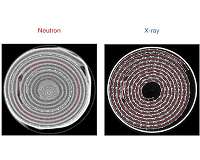
Reconstructed tomograms from neutron and X-ray computed tomography. Clearly visible in the X-ray images is the nickel current collecting mesh, which appears brighter than the active electrode material.

An international team led by researchers at UCL has revealed new insights into the workings of a lithium battery by virtually "unrolling" its coil of electrode layers using an algorithm designed for papyrus scrolls.

In a study published in Nature Communications researchers combined X-ray and neutron tomography to track the processes deep within a lithium battery during discharge. They then used a mathematical model designed for ancient manuscripts too sensitive to be physically opened to "unroll" the electrode layers, so aiding analysis and revealing that different sections of the battery were operating differently.

Researchers found that using the two complementary imaging techniques and "unrolling" the electrodes while they are in normal use provides a fuller and more accurate understanding of how the battery works and how, where and why it degrades over time. Unseen trends in the spatial distribution of performance in the cells were observed.

The method paves the way for developing strategies for improving the design of cylindrical cells using a range of battery chemistries, including by informing better mathematical models of battery performance. As such the method may facilitate improvements in the range and lifetime of electric vehicles of the future.

The project was funded by the Faraday Institution, as part of its battery degradation project.

Further details
The team investigated the processes occurring during discharge of a cylindrical commercial Li-ion primary cell from Duracell using a combination of two highly complementary tomography methods. Tomography is a technique for displaying a representation of a cross section through a solid object through the use of a penetrating wave such as ultrasound or X-rays. The method is used in radiology, archaeology, atmospheric science, geophysics, oceanography as well as materials science.

X-rays are sensitive to heavier elements in the battery - such as manganese and nickel, and neutrons are sensitive to lighter elements - lithium and hydrogen, allowing the two techniques to visualise different parts of the battery structure and allowing researchers to build up a more complete understanding of the processes occurring deep within the cell during battery discharge.

X-ray computed tomography allowed for the quantification of mechanical degradation effects such as electrode cracking from the electrode bending process during cell manufacturing. Whereas the imaging using neutrons yielded information about the electrochemistry such as lithium-ion transport and consumption or gas formation by electrolyte decay.

A new mathematical method developed at the Zuse-Institut in Berlin then enabled researchers to virtually unwind the battery electrodes that are wound into the form of a compact cylinder. The cylindrical windings of the battery are difficult to examine quantitatively, and the cell cannot be unwound without inducing further damage that would not be present in an unwound battery.

Research Report: "4D imaging of Li-batteries using operando neutron and X-ray computed tomography in combination with a virtual unrolling technique,"


Related Links
The Faraday Institution
Powering The World in the 21st Century at Energy-Daily.com

ENERGY TECH
Static electricity as strong as lightening can be saved in a battery
Pohang, South Korea (SPX) Feb 07, 2020
Static electricity shock which occurs more often in winter is unpleasant. When two different objects are in repeated contact, it causes friction which then creates static electricity. This can be found easily in our everyday actions and it is very annoying even between the lovers. In fact, there is no electric current flowing in static electricity but tens of thousands of volts occurs, equal to the power of lightening. Then, can we collect static electricity for use? The answer is yes. Pro ... read more

Comment using your Disqus, Facebook, Google or Twitter login.

Share this article via these popular social media networks
del.icio.usdel.icio.us DiggDigg RedditReddit GoogleGoogle

ENERGY TECH
As nations bicker, a greener future evolves in finance

Model shows how to make on-farm sustainable energy projects profitable

Eastern EU states opposed to 2050 zero-emissions goal

New research could aid cleaner energy technologies

ENERGY TECH
New droplet-based electricity generator: A drop of water generates 140V power, lighting up 100 LED bulbs

Scientists learn more about the first hours of a lithium-ion battery's life

Scientists offer an inkjet printing technology to make compact, flexible battery elements

Static electricity as strong as lightening can be saved in a battery

ENERGY TECH
UK looks to offshore wind for green energy transition

Britain's green energy sector brightens: survey data

Consider marine life when implementing offshore renewable power

Supporting structures of wind turbines contribute to wind farm blockage effect

ENERGY TECH
Solar Resource Compass improves solar irradiance data selection and estimates impacts of soiling and snow

CIGSe thin-film solar cells: EU Sharc25 project increases efficiency

Simple, solar-powered water desalination

Lasers etch a 'perfect' solar energy absorber

ENERGY TECH
GE Hitachi Nuclear Energy and CEZ signs small modular reactor tech deal with Czech Republic

Framatome signs contracts with Tennessee Valley Authority

GE Hitachi Nuclear Energy begins NRC licensing process for BWRX-300 Small Modular Reactor

Molecule modification could improve reprocessing of spent nuclear fuel

ENERGY TECH
Drilling a 3,000 meters deep well

Water-conducting membrane allows carbon dioxide to transform into fuel more efficiently

Vast amounts of valuable energy, nutrients, water lost in world's fast-rising wastewater streams

UCF researchers work on project to develop cleaner-burning, renewable fuels

ENERGY TECH
Russia boosts oil supply to India

Cyprus orders missiles amid Turkey gas tensions

Norway's Equinor sets green goals but activists not satisfied

Report reveals elevated benzene levels at 10 U.S. oil refineries

ENERGY TECH
UN talks struggle to stave off climate chaos

Climate takes centre stage at Siemens shareholder meet

UK vows action after envoy slams plans for UN climate talks

Arctic permafrost thaw plays greater role in climate change than previously estimated