
ENERGY TECH
Researchers develop calcium rechargeable battery with long cycle life
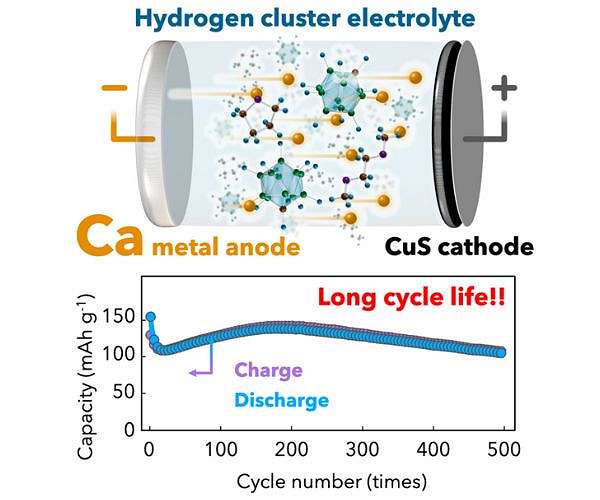
Schematic of a prototype Ca metal battery. The battery comprises a Ca2+ storing positive electrode containing the CuS cathode and Ca metal anode with a hydrogen cluster electrolyte. Cycling performance of the Ca-CuS battery.
Researchers develop calcium rechargeable battery with long cycle life
by Staff Writers
Sendai, Japan (SPX) May 24, 2023
A research group has developed a prototype calcium (Ca) metal rechargeable battery capable of 500 cycles of repeated charge-discharge - the benchmark for practical use. With the use of electric vehicles and grid-scale energy storage systems on the rise, the need to explore alternatives to lithium-ion batteries (LIBs) has never been greater.

One such replacement is Ca metal batteries. As the fifth most abundant element in earth's crust, calcium is widely available and inexpensive, and has higher energy density potential than LIBs. Its properties are also thought to help accelerate ion transport and diffusion in electrolytes and cathode materials, giving it an edge over other LIB-alternatives such as magnesium and zinc.

But many hurdles remain in the way of Ca metal batteries' commercial viability. The lack of an efficient electrolyte and the absence of cathode materials with sufficient Ca2+ storage capabilities have proved to be the main stumbling blocks.

Back in 2021, some members of the current research group provided a solution to the former problem when they realized a new fluorine-free calcium (Ca) electrolyte based on a hydrogen (monocarborane) cluster. The electrolyte demonstrated markedly improved electrochemical performances such as high conductivity and high electrochemical stabilities.

"For our current research, we tested the long-term operation of a Ca metal battery with a copper sulfide (CuS) nanoparticle/carbon composite cathode and a hydride-based electrolyte," says Kazuaki Kisu, assistant professor at Tohoku University's Institute for Materials Research (IMR).

Also a natural mineral, CuS has favorable electrochemical properties. Its layered structure enables it to store a variety of cations, including lithium, sodium and magnesium. It has a large theoretical capacity of 560 mAh g-1 - two to three times higher than present cathode materials for lithium-ion batteries.

Through nanoparticulation and compositing with carbon materials, Kisu and his collegues were able to create a cathode capable of storing large amounts of calcium ions. When employed with the hydride-type electrolyte, they produce a battery with a highly stable cycling performance. The prototype battery maintained 92% capacity retention over 500 cycles based on the capacity of the 10th cycle.

The group is confident that their breakthrough will help advance research into cathode materials for Ca-based batteries. "Our study confirms the feasibility of Ca metal anodes for long-term operations, and we are hopeful the results will expedite the development of Ca metal batteries," says Kisu.

The breakthrough was reported in the journal Advanced Science on May 19, 2023.

Research Report:Calcium Metal Batteries with Long Cycle Life Using a Hydride-Based Electrolyte and Copper Sulfide Electrode

Related Links
Tohoku University
Powering The World in the 21st Century at Energy-Daily.com

Tweet

ENERGY TECH
Flexing crystalline structures provide path to a solid energy future
Durham NC (SPX) May 24, 2023
A team of researchers at Duke University and their collaborators have uncovered the atomic mechanisms that make a class of compounds called argyrodites attractive candidates for both solid-state battery electrolytes and thermoelectric energy converters. The discoveries-and the machine learning approach used to make them-could help usher in a new era of energy storage for applications such as household battery walls and fast-charging electric vehicles. "This is a puzzle that has not been cracked be ... read more

ENERGY TECH
Five Eyes: China-sponsored hackers spying on U.S. infrastructure

$45 million in DOE grants will help non-profits cut energy use in buildings

France unveils new, more ambitious emissions-cutting plan

Climate activists put the heat on shareholder meetings

ENERGY TECH
France to open its first electric car battery factory

Researchers develop calcium rechargeable battery with long cycle life

Flexing crystalline structures provide path to a solid energy future

Small-scale proton exchange membrane fuel cells

ENERGY TECH
Brazil faces dilemma: endangered macaw vs. wind farm

Spire to provide TrueOcean with weather forecasts for offshore wind farm development

Sweden greenlights two offshore windpower farms

European leaders vow to boost North Sea wind energy production

ENERGY TECH
Controlling crystal lattices of hybrid solar cell materials with terahertz light

Controlling crystal lattices of hybrid solar cell materials with terahertz light

The NEM 3.0 Debacle: A Dark Cloud Over California's Solar Industry

Solar investment outshines oil: IEA

ENERGY TECH
UN nuclear chief to brief Security Council on Ukrainian power plant

Framatome announces relaunch of Nuclear Technology Academy to support hiring needs

Overcoming nuke stigma through critical thinking

Zaporizhzhia nuclear plant reconnected to Ukraine grid

ENERGY TECH
E-fuels - DLR selects Leuna as location for its PtL technology platform

WVU researcher searching for 'holy grail' of sustainable bioenergy

New catalyst transforms carbon dioxide into sustainable byproduct

Researchers cultivate microalgae for biofuel production

ENERGY TECH
Iraq budget vote delayed as Kurds oppose amendments on oil

Oil majors go slow on green transition despite pressure

Iraq warned to end oil addiction to avoid 'intensive care'

TotalEnergies shareholders back oil giant's climate strategy despite protests

ENERGY TECH
Glue, soup and grit: the new climate activism

Climate scientists flee Twitter as hostility surges

Germany gets tough with climate activists

German police in nationwide raids against climate activists