
ENERGY TECH
New study explains why superconductivity takes place in graphene
by Staff Writers
Espoo, Finland (SPX) Mar 04, 2020

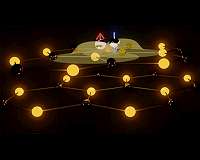
Artist's view of bilayer graphene. Antti Paraoanu.

Graphene, a single sheet of carbon atoms, has many extreme electrical and mechanical properties. Two years ago, researchers showed how two sheets laid on top of each other and twisted at just the right angle can become superconducting, so that the material loses its electrical resistivity. New work explains why this superconductivity happens in a surprisingly high temperature.

Researchers at Aalto University and the University of Jyvaskyla showed that graphene can be a superconductor at a much higher temperature than expected, due to a subtle quantum mechanics effect of graphene's electrons. The results were published in Physical Review B. The findings were highlighted in Physics viewpoint by the American Physical Society, and looks set to spark lively discussion in the physics community.

The discovery of the superconducting state in twisted bilayer graphene was selected as the Physics breakthrough of the year 2018 by the Physics World magazine, and it spurred an intense debate among physicist about the origin of superconductivity in graphene.

Although superconductivity was found only at a few degrees above the absolute zero of temperature, uncovering its origin could help understanding high-temperature superconductors and allow us to produce superconductors that operate near room temperature. Such a discovery has been considered one of the "holy grails" of physics, as it would allow operating computers with radically smaller energy consumption than today.

The new work came from a collaboration between Paivi Torma's group at Aalto University and Tero Heikkila's group at the University of Jyvaskyla. Both have studied the types of unusual superconductivity most likely found in graphene for several years.

"The geometric effect of the wave functions on superconductivity was discovered and studied in my group in several model systems. In this project it was exciting to see how these studies link to real materials", says the main author of the work, Aleksi Julku from Aalto University. "Besides showing the relevance of the geometric effect of the wave functions, our theory also predicts a number of observations that the experimentalists can check", explains Teemu Peltonen from the University of Jyvaskyla.

Research paper


Related Links
Aalto University
Powering The World in the 21st Century at Energy-Daily.com

ENERGY TECH
Generating electricity 'out of thin air'
Amherst MA (SPX) Feb 24, 2020
Scientists at the University of Massachusetts Amherst have developed a device that uses a natural protein to create electricity from moisture in the air, a new technology they say could have significant implications for the future of renewable energy, climate change and in the future of medicine. As reported in Nature, the laboratories of electrical engineer Jun Yao and microbiologist Derek Lovley at UMass Amherst have created a device they call an "Air-gen." or air-powered generator, with electri ... read more

Comment using your Disqus, Facebook, Google or Twitter login.

Share this article via these popular social media networks
del.icio.usdel.icio.us DiggDigg RedditReddit GoogleGoogle

ENERGY TECH
Coronavirus outbreak slashes China carbon emissions: study

Extreme weather to overload urban power grids, study shows

EU chief pleads to save green deal in budget holed by Brexit

Carbon emissions from energy 'flat' in 2019: IEA

ENERGY TECH
Isotope movement holds key to the power of fusion reactions

Design of the W7-X fusion device enables it to overcome obstacles

Generating electricity 'out of thin air'

Cobalt supply can meet demand for electric vehicle and electronics batteries

ENERGY TECH
Opportunity blows for offshore wind in China

Alphabet cuts cord on power-generating kite business

Iberdrola will build its next wind farm in Spain with the most powerful wind turbine

UK looks to offshore wind for green energy transition

ENERGY TECH
Trina Solar launches 500W ultra-high-power modules

SCE goes back to manual paper billing after smart meter fiasco

Urban use of ultralight flexible CIGS thin film solar cells

Kimberly-Clark backs local 3MW solar farm in LaGrange, Georgia

ENERGY TECH
Framatome opens new research and operations center and expands Intercontrole in Cadarache, France

VTT develops a Small Modular Reactor for district heating

France begins shutting down oldest nuclear plant

DR Congo govt gives go-ahead to restarting nuclear reactor

ENERGY TECH
Using open-source software to analyze economics of biofuels, bioproducts

Can palm-oil biodiesel can reduce greenhouse gas emissions

Novel photocatalytic method converts biopolyols and sugars into methanol and syngas

New method converts carbon dioxide to methane at low temperatures

ENERGY TECH
Canada oil firm apologizes for sexualized 'Greta' image

Rust and light a possible answer to the conundrum of hydrogen fuel production

Firm scraps bid to drill off pristine Australian coast

NGOs take Norway to Supreme Court over Arctic oil

ENERGY TECH
Brazil, US 'rolling back' on climate: UN rights chief

'Activism works': Greta Thunberg rallies UK school strikers

Army called in to help drought-hit New Zealand towns

DNA from ancient packrat nests reveals Earth's ecological history