As a vehicle travels through space at hypersonic speeds, the gases surrounding it generate heat at dangerous temperatures for the pilot and instrumentation inside. Designing a vehicle that can drive the heat away requires an understanding of the thermal properties of the materials used to construct it. A recent two-part study at the University of Illinois Urbana-Champaign developed a method to create 3D models of the fibers within composite materials then used that information to predict the thermal conductivity of the material.
"We used X-ray microtomography to create 3D images that show the orientation of the fibers," said Francesco Panerai, a faculty member in the Department of Aerospace Engineering at UIUC. "In most engineering applications we use composite materials made with carbon fibers, but the method we developed can be applied to any kind of fiber and any kind of composite."
Panerai said microtomography is similar to getting a CT scan in the hospital, but with high energy X-rays that can detect fine details in microfibers, which are a fraction of the diameter of a single human hair.
"The images showing how the fibers are organized are much more than just pretty pictures–they are a description of the material in a three-dimensional grid. Now we can use the data from the 3D grid to do simulations to compute material properties for which you would otherwise have to do complicated experiments," Panerai said.
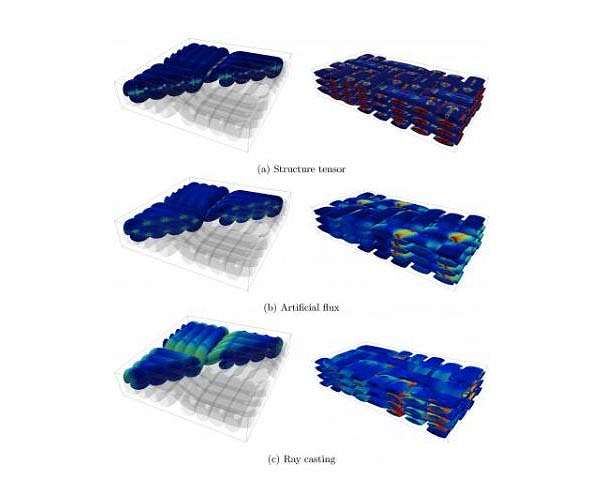
In part one of the study, Panerai and his colleagues tested three different methods to visualize the fibers. "We found that because different materials are made up of different architectures, certain methods worked better with some fibers and weaves than with others."
For example, the study concluded that the ubiquitous structure tensor approach showed very good performance on straight, random fibers, but failed to accurately estimate the orientation of a two-direction densely packed weave.
Another method based on the artificial flux demonstrated relatively good performance on two-direction woven samples, but it failed on straight random fibers.
The novel ray casting method showed promise to become a powerful approach to estimate the orientation of fibrous materials with little curvature. But, its main disadvantage is the high computational cost.
"Now that we can follow the direction of the fibers in space and determine the space between them, we can compute the material property, in this case its thermal conductivity, in three dimensions and have very accurate values.
"And, to measure conductivity experimentally, you'd need to do three experiments, one for each direction. Using this new method, we can compute the tensor and predict properties in the three directions far more rapidly and cost effectively."
Panerai said this new method to visualize fibers and the proven ability to determine material properties can help re-engineer materials.
"We can use a very specific fiber architecture to achieve a certain property such as strength or conductivity," he said. "Thermal conductivity is something everyone who works on high temperature materials tries estimate. It seems like a very simple property, but it is very hard to measure, especially for materials that are three dimensional. That's what is remarkable about the power of this method."
Frederico Semeraro, lead author of the study at NASA Ames Research Center, said, "Computing the thermal conductivity is critical to reliably predict a heat shield response. In addition, the methodology and numerical methods that have been developed are flexible enough to allow the computation of many material properties. A comprehensive understanding of the behavior of a heatshield will ultimately enable the optimization of its design."