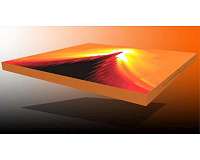
A discovery that long eluded physicists has been detected in a laboratory at Princeton. A team of physicists detected superconducting currents – the flow of electrons without wasting energy – along the exterior edge of a superconducting material. The finding was published in the May 1 issue of the journal Science.
The superconductor that the researchers studied is also a topological semi-metal, a material that comes with its own unusual electronic properties. The finding suggests ways to unlock a new era of "topological superconductivity" that could have value for quantum computing.
"To our knowledge, this is the first observation of an edge supercurrent in any superconductor," said Nai Phuan Ong, Princeton's Eugene Higgins Professor of Physics and the senior author on the study.
"Our motivating question was, What happens when the interior of the material is not an insulator but a superconductor?" Ong said. "What novel features arise when superconductivity occurs in a topological material?"
Although conventional superconductors already enjoy widespread usage in magnetic resonance imaging (MRI) and long-distance transmission lines, new types of superconductivity could unleash the ability to move beyond the limitations of our familiar technologies.
Researchers at Princeton and elsewhere have been exploring the connections between superconductivity and topological insulators – materials whose non-conformist electronic behaviors were the subject of the 2016 Nobel Prize in Physics for F. Duncan Haldane, Princeton's Sherman Fairchild University Professor of Physics.
Topological insulators are crystals that have an insulating interior and a conducting surface, like a brownie wrapped in tin foil. In conducting materials, electrons can hop from atom to atom, allowing electric current to flow. Insulators are materials in which the electrons are stuck and cannot move. Yet curiously, topological insulators allow the movement of electrons on their surface but not in their interior.
To explore superconductivity in topological materials, the researchers turned to a crystalline material called molybdenum ditelluride, which has topological properties and is also a superconductor once the temperature dips below a frigid 100 milliKelvin, which is -459 degrees Fahrenheit.
"Most of the experiments done so far have involved trying to 'inject' superconductivity into topological materials by putting the one material in close proximity to the other," said Stephan Kim, a graduate student in electrical engineering, who conducted many of the experiments. "What is different about our measurement is we did not inject superconductivity and yet we were able to show the signatures of edge states."
The team first grew crystals in the laboratory and then cooled them down to a temperature where superconductivity occurs. They then applied a weak magnetic field while measuring the current flow through the crystal. They observed that a quantity called the critical current displays oscillations, which appear as a saw-tooth pattern, as the magnetic field is increased.
Both the height of the oscillations and the frequency of the oscillations fit with predictions of how these fluctuations arise from the quantum behavior of electrons confined to the edges of the materials.
Researchers have long known that superconductivity arises when electrons, which normally move about randomly, bind into twos to form Cooper pairs, which in a sense dance to the same beat. "A rough analogy is a billion couples executing the same tightly scripted dance choreography," Ong said.
The script the electrons are following is called the superconductor's wave function, which may be regarded roughly as a ribbon stretched along the length of the superconducting wire, Ong said. A slight twist of the wave function compels all Cooper pairs in a long wire to move with the same velocity as a "superfluid" – in other words acting like a single collection rather than like individual particles – that flows without producing heating.
If there are no twists along the ribbon, Ong said, all Cooper pairs are stationary and no current flows. If the researchers expose the superconductor to a weak magnetic field, this adds an additional contribution to the twisting that the researchers call the magnetic flux, which, for very small particles such as electrons, follows the rules of quantum mechanics.
The researchers anticipated that these two contributors to the number of twists, the superfluid velocity and the magnetic flux, work together to maintain the number of twists as an exact integer, a whole number such as 2, 3 or 4 rather than a 3.2 or a 3.7. They predicted that as the magnetic flux increases smoothly, the superfluid velocity would increase in a saw-tooth pattern as the superfluid velocity adjusts to cancel the extra .2 or add .3 to get an exact number of twists.
The team measured the superfluid current as they varied the magnetic flux and found that indeed the saw-tooth pattern was visible.
In molybdenum ditelluride and other so-called Weyl semimetals, this Cooper-pairing of electrons in the bulk appears to induce a similar pairing on the edges.
The researchers noted that the reason why the edge supercurrent remains independent of the bulk supercurrent is currently not well understood. Ong compared the electrons moving collectively, also called condensates, to puddles of liquid.
"From classical expectations, one would expect two fluid puddles that are in direct contact to merge into one," Ong said. "Yet the experiment shows that the edge condensates remain distinct from that in the bulk of the crystal."
The research team speculates that the mechanism that keeps the two condensates from mixing is the topological protection inherited from the protected edge states in molybdenum ditelluride. The group hopes to apply the same experimental technique to search for edge supercurrents in other unconventional superconductors.
"There are probably scores of them out there," Ong said.