
ENERGY TECH
Manganese may finally solve hydrogen fuel cells' catalyst problem
by Staff Writers
Buffalo NY (SPX) Oct 30, 2018

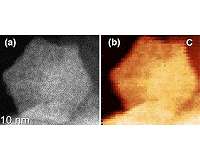
The image on the left shows manganese catalyst particle shape. The right images shows the uniform elemental distribution of carbon throughout the particle.R

Manganese is known for making stainless steel and aluminum soda cans. Now, researchers say the metal could advance one of the most promising sources of renewable energy: hydrogen fuel cells.

In a study published in the journal Nature Catalysis, a University at Buffalo-led research team reports on catalysts made from the widely available and inexpensive metal.

The advancement could eventually help solve hydrogen fuel cells' most frustrating problem: namely, they're not affordable because most catalysts are made with platinum, which is both rare and expensive.

"We haven't been able to advance a large-scale hydrogen economy because of this issue involving catalysts. But manganese is one of the most common elements in Earth's crust and it's widely distributed across the planet. It could finally address this problem," says lead author Gang Wu, PhD, associate professor of chemical and biological engineering in UB's School of Engineering and Applied Sciences.

Additional authors come from Oak Ridge National Laboratory, Brookhaven National Laboratory, Argonne National Laboratory, Oregon State University, University of Pittsburgh, University of South Carolina, Giner Inc. and Harbin Institute of Technology.

For more than a decade, Wu has been searching for alternative catalysts for hydrogen fuel cells. He has reported advancements in iron- and cobalt-based catalysts; however, each wears down over time, limiting their usefulness, he says.

In previous work, Wu discovered that adding nitrogen to manganese causes internal changes to the metal that makes it a more stable element. In experiments reported in the study, he devised a relatively simple two-step method of adding carbon and a form of nitrogen called tetranitrogen to manganese.

The result was a catalyst that's comparable in its ability to split water - the reaction needed to produce hydrogen - as platinum and other metal-based alternatives. More importantly, the stability of the catalyst makes it potentially suitable for hydrogen fuel cells. This could lead to wide-scale adoption of the technology in buses, cars and other modes of transportation, as well as backup generators and other sources of power.

Wu plans to continue the research, focusing on improving the catalyst's carbon microstructure and the method in which nitrogen is added. The goal, he says, is to further enhance the catalyst's performance in practical hydrogen fuel cells.

Research paper


Related Links
University at Buffalo
Powering The World in the 21st Century at Energy-Daily.com

ENERGY TECH
Scientists unravel the mysteries of polymer strands in fuel cells
Washington DC (SPX) Oct 25, 2018
Hydrogen fuel cells offer an attractive source of continuous energy for remote applications, from spacecraft to remote weather stations. Fuel cell efficiency decreases as the Nafion membrane, used to separate the anode and cathode within a fuel cell, swells as it interacts with water. A Russian and Australian collaboration has now shown that this Nafion separator membrane partially unwinds some of its constituent fibers, which then protrude away from the surface into the bulk water phase for hundr ... read more

Comment using your Disqus, Facebook, Google or Twitter login.

Share this article via these popular social media networks
del.icio.usdel.icio.us DiggDigg RedditReddit GoogleGoogle

ENERGY TECH
Spain's Ibedrola sells hydro, gas-powered assets in U.K. for $929M

How will climate change stress the power grid

Electricity crisis leaves Iraqis gasping for cool air

Energy-intensive Bitcoin transactions pose a growing environmental threat

ENERGY TECH
Chilean court authorizes Chinese group's lithium production purchase

Whiskers, surface growth and dendrites in lithium batteries

Nanotubes may give the world better batteries

Scientists unravel the mysteries of polymer strands in fuel cells

ENERGY TECH
Extreme weather forcing renewable operators to strengthen project economics

Wind farms and reducing hurricane precipitation

Ingeteam opens new high-tech production facility for electrical wind turbine components in India

Wind turbine installation vessel launching and construction supervision contract

ENERGY TECH
Highly efficient wet-processed solar cells with molecules in the same orientation

China's solar subsidy cuts will help US developers to revive projects and jobs, says GlobalData

Poor Ivory Coast pupils' ray of hope: solar backpacks

How graphite is lighting the way to a solar future

ENERGY TECH
Russia, Uzbekistan hail $11 bn nuclear plant project during Putin visit

Scientists discover new properties of uranium compounds

US curbs China nuclear exports as Trump warns Americans not 'stupid'

At Le Creusot, dimensional inspection of test pieces is going digital

ENERGY TECH
Efficient electrochemical cells for CO2 conversion

Brazilian biomass-powered electricity expands 11 percent over last year

New catalyst opens door to CO2 capture in conversion of coal to liquid fuels

Sebigas Awarded For The Construction Of The Biggest Biogas Plant In The Americas

ENERGY TECH
Crude futures rise Thursday with 'little' more room for upside, analyst says

Drought-hit Rhine forces Germany to tap oil reserves

ConocoPhillips paid $345M by Venezuela over 2007 expropriation

Crude oil futures volatile Friday amid investor risk concerns

ENERGY TECH
Canada to impose carbon tax on provinces bucking climate action

Drought cripples crucial German waterways

Hotter temps, human activity explain increase in storm runoff, flash floods

New research identifies two types of drought across China and how they evolve