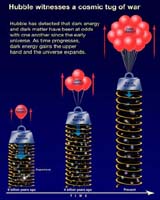
The "cosmic tug of war" that has been going on since the beginning of the universe is illustrated here in this chart.
The "cosmic tug of war" that has been going on since the beginning of the universe is illustrated here in this chart. |
Astronomers used the supernovae to measure the expansion rate of the universe and determine how the expansion rate is affected by the repulsive push of dark energy, a mysterious energy force that pervades space. Supernovae provide reliable measurements because their intrinsic brightness is well understood. They are therefore reliable distance markers, allowing astronomers to determine how far away they are from Earth.
Pinpointing supernovae in the faraway universe is similar to watching fireflies in your back yard. All fireflies glow with about the same brightness. So, you can judge how the fireflies are distributed in your back yard by noting their comparative faintness or brightness, depending on their distance from you.
Only Hubble can measure these supernovae because they are too distant, and therefore too faint, to be studied by the largest ground-based telescopes.
These Hubble observations show for the first time that dark energy has been a present force for most of the universe's history. A spectral analysis also shows that the supernovae used to measure the universe's expansion rate today look remarkably similar to those that exploded nine billion years ago and are just now seen by Hubble.
These latest results are based on an analysis of the 24 most distant known supernovae, most of them discovered within the last three years by the Higher-z SN Search Team. The images were taken between 2003 and 2005 with Hubble's Advanced Camera for Surveys.
Community
 American Astronomical Society Statement On Arecibo Observatory
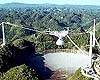 Madison WI (SPX) Nov 16, 2006
| The content herein, unless otherwise known to be public domain, are Copyright 1995-2006 - SpaceDaily.AFP and UPI Wire Stories are copyright Agence France-Presse and United Press International. ESA PortalReports are copyright European Space Agency. All NASA sourced material is public domain. Additionalcopyrights may apply in whole or part to other bona fide parties. Advertising does not imply endorsement,agreement or approval of any opinions, statements or information provided by SpaceDaily on any Web page published or hosted by SpaceDaily. Privacy Statement |