Physicists have unraveled a mystery behind the strange behavior of electrons in a ferromagnet, a finding that could eventually help develop high temperature superconductivity.
A Rutgers co-authored study of the unusual ferromagnetic material appears in the journal Nature.
The Rutgers Center for Materials Theory, a world leader in the field, studies "quantum phase transitions." Phase transitions, such as when ice melts, usually require heat to jiggle atoms and melt ice crystals. Quantum phase transitions are driven by the jiggling of atoms and electrons that result from fluctuations that never cease even at low temperatures.
A quantum phase transition can be achieved by tuning a material to enhance quantum fluctuations, either by applying a magnetic field or exposing it to intense pressure when the temperature is near absolute zero. In certain quantum phase transitions, the quantum fluctuations become infinitely intense, forming a "quantum critical point." These unusual states of matter are of great interest because of their propensity to form superconductors. Think of it as like an electronic stem cell, a form of matter that can transform itself in many ways.
Meanwhile, in the weird world of quantum mechanics, "entanglement" allows something to be in two different states or places at the same time. The Austrian physicist Erwin Schrodinger's famous thought experiment, which features a cat that is simultaneously dead and alive, is an example of entanglement.
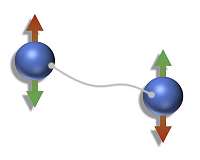
Inside materials with electrons moving through them, entanglement often involves the spin of electrons, which can be simultaneously up and down. Typically, only electrons near each other are entangled in quantum materials, but at a quantum critical point, the entanglement patterns can change abruptly, spreading out across the material and transforming it. Electrons, even distant ones, become entangled.
Ferromagnets are an unlikely setting for studying quantum entanglement because the electrons moving through them align in one direction instead of spinning up and down. But physicists found that the ferromagnetism in "Cerge," (CeRh6Ge4) a ferromagnet, must have a large amount of entanglement with electrons that spin up and down and are connected with each other. That had never been seen in ferromagnets.
"We believe our work, connecting entanglement with the strange metal and ferromagnets, provides important clues for our efforts to understand superconductors that work at room temperature," said co-author Piers Coleman, a professor in the Department of Physics and Astronomy in the School of Arts and Sciences at Rutgers University-New Brunswick. "As we learn to understand how nature controls entanglement in matter, we hope we'll develop the skills to control quantum entanglement inside quantum computers and to design and develop new kinds of quantum matter useful for technology."
Rutgers scientists have used some of their findings to propose a new theory for a family of iron-based superconductors that were discovered about 10 years ago. "If we are right, these systems, like ferromagnets, are driven by forces that like to align electrons," Coleman said.
Yashar Komijani, a Rutgers post-doctoral associate, is one of three co-lead authors. Scientists at Zhejiang University in China, Max Planck Institute for Chemical Physics of Solids in Germany and Nanjing University in China contributed to the study.