The research team led by Dr. Kim Tae-hoon of the Department of Functional Composites of the Composites Research Division at the Korea Institute of Materials Science (KIMS, President Jung-hwan Lee), a government-funded research institute under the Ministry of Science and ICT, succeeded in developing the world's first multifunctional carbon nanotube fiber which simultaneously achieves high energy storage capacity and high strength, together with the research team of Professor Yang Seung-Jae of Inha University (President Myung Woo Cho).
Most of the existing energy storage and structural materials have only one property between high strength or high energy storage capacity. By using carbon nanotube fiber that is light, strong, and has excellent electrical conductivity, the material developed by the two research teams has both properties simultaneously.
The research team applied surface treatment on carbon nanotube fibers and produced a high-strength fiber-type supercapacitor by inducing the growth of porous carbon. This enabled the synthesis of new fibrous material with energy storage properties while maintaining the strength of carbon nanotube fibers. The researchers confirmed that the fiber-type supercapacitor stably operates while supporting a heavyweight.
Supercapacitor: An energy storage device that has a smaller storage capacity than a lithium secondary battery, but can accept and deliver charge/discharge much faster than other batteries.
The existing technology required a separate material to support the battery and the load, but the newly-developed material can successfully play the both roles, which is significant for suggesting a new direction for the development of lightweight materials. In particular, the multifunctional carbon nanotube fiber technology is expected to be used in electric vehicles, drones, and aerospace/aviation fields that require weight reduction.
Carbon nanotube fiber is drawing attention as a next-generation material. There is only one company in the US that is practically utilizing the technology for mass production. Through the localization of the material, it is expected to substitute the import as well as to be available for export.
Dr. Kim Tae-hoon, a senior researcher at KIMS, said, "Using multifunctional carbon nanotube fibers can help improve the driving distance of future mobility such as drones. It is expected to apply to the aerospace, aviation, and defense that require lightweight, high strength, and high conductivity."
The research was supported by Energy Production and Storage Material Convergence Property Tailoring-type Textile Material Technology Development Project of KIMS and the 4U Composite Material Development Project, an open research project, of the Korea Institute of Science and Technology, with support from the Ministry of Science and ICT. In addition, the research was published in Science Advances, a sister journal of Science, which is a world-class academic journal, on January 5th.
Meanwhile, the research team is conducting follow-up research on bulletproof materials and ultra-light composite materials, utilizing the research outcomes, and developing mass-production methods as well as electromagnetic wave shielding of CNT fibers.
Existing lithium secondary batteries, energy storage devices, do not withstand mechanical loads by themselves. On the other hand, structural materials including steel and aluminum are strong but, of course, they cannot store energy.
If a material can have both energy storage capacity and structurally excellent property, it can become an outer cover for vehicles and drones, and replace the existing battery, which reduces the weight and increase the driving distance.
To this end, a new material that is light and has excellent mechanical strength and good electrical conductivity is required to make a battery. The only material for this purpose is carbon nanotube fibers.
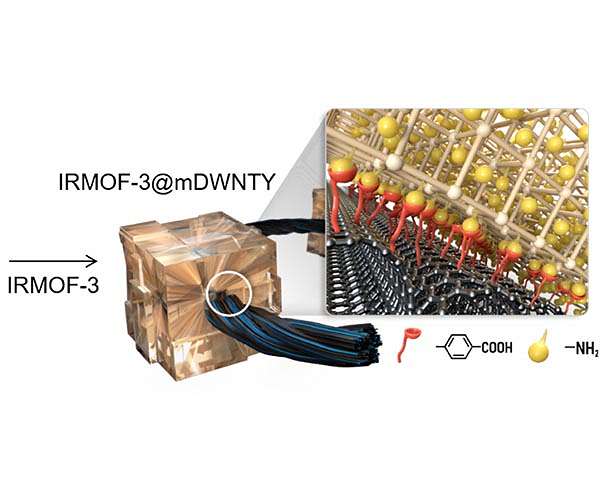
The research team synthesized carbon nanotube fibers with excellent electrical conductivity and tensile strength and induced the growth of porous carbon to store energy. In addition, they additionally increased the strength of carbon nanotube fibers and applied surface treatment so that porous carbon can be firmly attached without falling from the fibers. Ultimately, they succeeded in synthesizing a multifunctional carbon nanotube fiber that can store energy while maintaining the strength and electrical conductivity of the original carbon nanotube fiber.
A fiber-type supercapacitor using the multifunctional carbon nanotube fiber has excellent mechanical properties and energy storage properties far superior to those of conventional fiber-type supercapacitors. In addition, the fiber-type supercapacitor, which looks like a thin thread, is stably charged and discharged while supporting a weight of 10 kg.
This research demonstrated that a new concept of supercapacitor fiber with structural and energy storage properties can be manufactured using carbon nanotube fibers. Based on the carbon nanotube fiber manufacturing and application technology, the research team plans to conduct follow-up studies to apply the result to electromagnetic wave shielding, composite materials, and secondary batteries.
By researching on improving the productivity of carbon nanotube fibers, the technology can be improved for mass production within a few years. In addition, the localization and self-reliance of the new material can contribute to becoming a material powerhouse.
Even though Korea is leading the carbon nanotube fiber R and D around the world, no domestic company has yet manufactured large quantities of standardized products. Huntsman of the US is the only company currently applying carbon nanotube fibers for mass production. As such, a proper market has not been established yet, and the fibers produced by Huntsman are only supplied to NASA and the US Department of Defense, thereby not available in the private market.