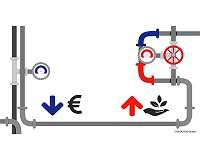
Geothermal energy is a renewable energy source that is available everywhere, notwithstanding changes in sunlight, wind, or ocean currents. The Earth's reservoirs of steam and hot water can be tapped to heat and cool buildings directly. In order to make the technology needed more affordable, and further improve its efficiency, seven countries, funded by the EU, have joined forces in order to reduce its cost by a quarter. The project is reaching its final stage and their first results are promising.
It is estimated that 75% of EU building stock is energy inefficient. This means that buildings across the EU hold untapped potential for renewables and energy efficiency. Such improvement would undoubtedly add to decarbonising the EU economy and help to achieve climate change goals worldwide.
The GEOCOND project is funded by Horizon 2020, the biggest EU research and innovation programme and has set out to upgrade shallow geothermal systems that have particular potential in this respect. Led by the Polytechnic University of Valencia, Spain, the project is a paradigm of international research cooperation with participants from Turkey and Israel among other countries.
Concrete solutions
One component where gains could be made is the grouting: the characteristics of the materials that hold the pipes in place in the borehole greatly influence the performance of the shallow geothermal systems. Therefore, researchers are working closely to advance the grouting technology and help to reduce its life-cycle cost by a quarter. In effect, the project will develop new high-conductivity borehole filling materials to transmit the ambient energy more effectively.
"The grout has to be conductive, as this helps to cut the cost of the system, which is currently expensive," says Ayten Caputcu, who leads the research contributed to GEOCOND by Turkish cement manufacturer Cimsa. The more conductive the grout, the more efficiently it will transmit the Earth's warmth to the water running in the closed loop, and the shorter the length of pipe (and the depth of the borehole) required to achieve the expected temperatures, she explains.
The more conductive the grout, the more efficiently it will transmit the Earth's warmth to the water running in the closed loop, and the shorter the length of pipe (and the depth of the borehole) required to achieve the expected temperatures, she says.
The porosity of the grout, the proportion of silica sand and the relative proportions of water and cement involved are key factors in this respect, Caputcu adds. Geocond is testing different 'recipes' in a bid to surpass the thermal conductivity and rheological – flow- and deformation-related – properties of the grouts that are currently on the market, she notes.
Further improvements are to be achieved through the inclusion of innovative additives. "We are developing carbon-based materials for use in cement formulations," says Burcu Saner Okan, who coordinates the GEOCOND work conducted at Sabanci University in Istanbul. These materials have a hybrid structure combining carbon and silica, she explains.