
ENERGY TECH
Flexible generators turn movement into energy
by Staff Writers
Houston TX (SPX) Jun 03, 2019

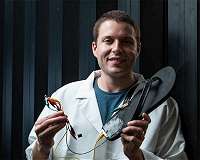
Rice University postdoctoral researcher Michael Stanford holds a flip-flop with a triboelectric nanogenerator, based on laser-induced graphene, attached to the heel. Walking with the flip-flop generates electricity with repeated contact between the generator and the wearer's skin. Stanford wired the device to store energy on a capacitor.

Wearable devices that harvest energy from movement are not a new idea, but a material created at Rice University may make them more practical.

The Rice lab of chemist James Tour has adapted laser-induced graphene (LIG) into small, metal-free devices that generate electricity. Like rubbing a balloon on hair, putting LIG composites in contact with other surfaces produces static electricity that can be used to power devices.

For that, thank the triboelectric effect, by which materials gather a charge through contact. When they are put together and then pulled apart, surface charges build up that can be channeled toward power generation.

In experiments, the researchers connected a folded strip of LIG to a string of light-emitting diodes and found that tapping the strip produced enough energy to make them flash. A larger piece of LIG embedded within a flip-flop let a wearer generate energy with every step, as the graphene composite's repeated contact with skin produced a current to charge a small capacitor.

"This could be a way to recharge small devices just by using the excess energy of heel strikes during walking, or swinging arm movements against the torso," Tour said.

The project is detailed in the American Chemical Society journal ACS Nano.

LIG is a graphene foam produced when chemicals are heated on the surface of a polymer or other material with a laser, leaving only interconnected flakes of two-dimensional carbon. The lab first made LIG on common polyimide, but extended the technique to plants, food, treated paper and wood.

The lab turned polyimide, cork and other materials into LIG electrodes to see how well they produced energy and stood up to wear and tear. They got the best results from materials on the opposite ends of the triboelectric series, which quantifies their ability to generate static charge by contact electrification.

In the folding configuration, LIG from the tribo-negative polyimide was sprayed with a protecting coating of polyurethane, which also served as a tribo-positive material. When the electrodes were brought together, electrons transferred to the polyimide from the polyurethane. Subsequent contact and separation drove charges that could be stored through an external circuit to rebalance the built-up static charge. The folding LIG generated about 1 kilovolt, and remained stable after 5,000 bending cycles.

The best configuration, with electrodes of the polyimide-LIG composite and aluminum, produced voltages above 3.5 kilovolts with a peak power of more than 8 milliwatts.

"The nanogenerator embedded within a flip-flop was able to store 0.22 millijoules of electrical energy on a capacitor after a 1-kilometer walk," said Rice postdoctoral researcher Michael Stanford, lead author of the paper. "This rate of energy storage is enough to power wearable sensors and electronics with human movement."

Research paper


Related Links
Rice University
Powering The World in the 21st Century at Energy-Daily.com

ENERGY TECH
Wearable cooling and heating patch could serve as personal thermostat and save energy
San Diego CA (SPX) May 23, 2019
Engineers at the University of California San Diego have developed a wearable patch that could provide personalized cooling and heating at home, work, or on the go. The soft, stretchy patch cools or warms a user's skin to a comfortable temperature and keeps it there as the ambient temperature changes. It is powered by a flexible, stretchable battery pack and can be embedded in clothing. Researchers say wearing it could help save energy on air conditioning and heating. "This type of device can impr ... read more

Comment using your Disqus, Facebook, Google or Twitter login.

Share this article via these popular social media networks
del.icio.usdel.icio.us DiggDigg RedditReddit GoogleGoogle

ENERGY TECH
Florida air conditioning pioneer first dismissed as a crank

Speed bumps on German road to lower emissions

World nations failing the poorest on energy goals: study

'Step-change' in energy investment needed to meet climate goals: IEA

ENERGY TECH
Wearable cooling and heating patch could serve as personal thermostat and save energy

Scientists revisit the cold case of cold fusion

Machine learning speeds modeling of experiments aimed at capturing fusion energy on Earth

Researchers set new mark for highest-temperature superconductor

ENERGY TECH
Can sound protect eagles from wind turbine collisions?

UK hits historic coal-free landmark

BayWa r.e. sells its first Australian wind farms to Epic Energy

The complicated future of offshore wind power in the US

ENERGY TECH
Solar cell defect mystery solved after decades of global effort

First stand-alone solar-powered poultry house

Renewables doesn't equal zero-carbon energy, and the difference is growing

Quantum rebar: Quantum dots enhance stability of solar-harvesting perovskite crystals

ENERGY TECH
World's second EPR nuclear reactor starts work in China

GE Hitachi begins vendor review of its BWRX-300 SMR with Canada's nuclear commission

Bio-inspired material targets oceans' uranium stores for sustainable nuclear energy

Iran to increase uranium, heavy water production: official

ENERGY TECH
Table scraps can be used to reduce reliance on fossil fuels

Where there's waste there's fertilizer

When biodegradable plastic isn't

Electrode's 'hot edges' convert CO2 gas into fuels and chemicals

ENERGY TECH
Aircraft from Lincoln CSG, B-52H conduct joint exercises in Arabian Sea

ExxonMobil staff to return to work in Iraq: ministry

US-UAE defense agreement comes into force

Fiery new Papua New Guinea PM questions vast Exxon, Total gas deal

ENERGY TECH
UK-led mission to improve climate change forecasts added to ESA mission

Merkel govt vows climate action as voters turn up heat

Warming Arctic to blame for increase in extreme weather

Merkel team talks climate as voters turn up heat