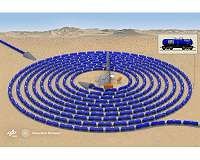
Energy researchers at the German Aerospace Center (Deutsches Zentrum fur Luft- und Raumfahrt; DLR) have developed a new idea for climate protection as part of a study. The key element is a surcharge on carbon dioxide, to be applied at the very beginning of the carbon cycle. Producers of oil, natural gas, coal and limestone could be obliged to store these materials near their production sites before selling them on.
This could be done either physically or virtually, using a cryptocurrency. In contrast to mechanisms such as carbon dioxide taxes or agreements on emissions trading, which are based on national laws or international regulations, the carbon dioxide curbing scheme proposed by the team at the DLR Institute of Engineering Thermodynamics would take the form of a global pact between citizens and industry.
Scenario one – curbing carbon dioxide through physical storage
In the first scenario, the companies store their output in railway wagons near the production site for a certain period of time. Only then are they allowed to feed the raw materials into the economic cycle. Investment in the necessary infrastructure – especially the wagons and railway tracks – will cause the prices of the stored products to rise. The storage time will depend on the raw material in question and the carbon dioxide emissions associated with its use.
The DLR researchers propose affixing QR codes to the top of the wagons so that the public can observe the process in action. These codes can be imaged by satellite and the related information made accessible on an online platform. In this scenario, the surcharge for storing natural gas for a four-month period would be approximately 100 euro per tonne of carbon dioxide.
Scenario two – curbing carbon dioxide through cryptocurrency mining
Due to the high cost of materials for physical storage, the DLR team has suggested a modification, by replacing the physical surcharge with a cryptocurrency called 'Carboncoin', which essentially constitutes a virtual surcharge. A cryptocurrency is a digital currency based on mathematical structures. Each of these structures is called a coin. In order to obtain these virtual coins, you have to 'mine' them, which involves time, computing power and electricity for computer farms.
In the study, DLR limits the number of Carboncoins to a maximum of 600 billion. This corresponds to the 600 billion tonnes of carbon dioxide that can still be emitted while keeping global warming below two degrees Celsius. The virtual surcharge obliges the companies to mine one Carboncoin for each raw material unit that is linked to one tonne of carbon dioxide. Blockchain technology, that is, the storage of information about mined coins in as many decentralised locations in the global network as possible, enables a high degree of transparency and control of this process.
Carbon dioxide curbing as an economic incentive for greater climate protection
Whether physical or virtual, a surcharge on carbon dioxide emissions sends a signal and represents a market-oriented incentive to focus more on renewable resources and the associated technologies. The use of fossil raw materials becomes more expensive, while the economic viability of renewable alternatives that contribute to the decarbonisation of the energy and mobility sectors increases.
Digging deeper
Three questions answered by Andre Thess, Director of the DLR Institute of Engineering Thermodynamics, creator of the study and head of the team of authors.
What is the status of the carbon dioxide curbing idea?
Thess: The study is a thought experiment – blue-sky research, as it were. We wanted to think through and perform the calculations for a completely different idea, despite the fact that it might seem somewhat far-fetched to many. This has culminated in a theoretical concept, which makes no statements about whether or how it might be implemented. Our aim was to give the climate discussion new, scientifically grounded impetus, and to point out possibilities that have been overlooked until now.
Why did you opt for a private initiative in the study, supported by citizens and companies?
Thess: Due to the diverse interests that states have to serve, it is often difficult for them to implement a consistent climate policy. Voluntary national and international agreements on climate protection are often criticised because they do not reliably reduce emissions, entail high administrative costs and are difficult to verify. We have therefore considered an approach to how climate protection could be implemented without state involvement – as a voluntary agreement between citizens and companies worldwide, with high standards of transparency and traceability.
Voluntary and worldwide – can that actually work?
Thess: This may all sound very utopian at first. Wikipedia is a free, digital reference work that is based on contributions from volunteers all over the world and has massively helped to democratise knowledge – it is a successful example of digital, global civil society. Around 60 companies are responsible for 70 to 80 percent of global carbon dioxide emissions. Perhaps it would be easier and worth a try to start there, rather than with the national governments of almost 200 states.