
ENERGY TECH
Could bread mold build a better rechargeable battery?
by Staff Writers
Washington DC (SPX) Mar 23, 2016


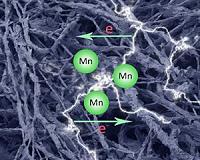
This is an artistic rendering of a carbonized fungal biomass-manganese oxide mineral composite (MycMnOx/C) can be applied as a novel electrochemical material in energy storage devices. Image courtesy Qianwei Li and Geoffrey Michael Gadd. For a larger version of this image please go here.

You probably don't think much of fungi, and especially those that turn bread moldy, but researchers reporting in the Cell Press journal Current Biology on March 17, 2016 have evidence that might just change your mind. Their findings suggest that a red bread mold could be the key to producing more sustainable electrochemical materials for use in rechargeable batteries.

The researchers show for the first time that the fungus Neurospora crassa can transform manganese into a mineral composite with favorable electrochemical properties.

"We have made electrochemically active materials using a fungal manganese biomineralization process," says Geoffrey Gadd of the University of Dundee in Scotland. "The electrochemical properties of the carbonized fungal biomass-mineral composite were tested in a supercapacitor and a lithium-ion battery, and it [the composite] was found to have excellent electrochemical properties. This system therefore suggests a novel biotechnological method for the preparation of sustainable electrochemical materials."

Gadd and his colleagues have long studied the ability of fungi to transform metals and minerals in useful and surprising ways. In earlier studies, the researchers showed that fungi could stabilize toxic lead and uranium, for example. That led the researchers to wonder whether fungi could offer a useful alternative strategy for the preparation of novel electrochemical materials too.

"We had the idea that the decomposition of such biomineralized carbonates into oxides might provide a novel source of metal oxides that have significant electrochemical properties," Gadd says.

In fact, there have been many efforts to improve lithium-ion battery or supercapacitor performance using alternative electrode materials such as carbon nanotubes and other manganese oxides. But few had considered a role for fungi in the manufacturing process.

In the new study, Gadd and his colleagues incubated N. crassa in media amended with urea and manganese chloride (MnCl2) and watched what happened. The researchers found that the long branching fungal filaments (or hyphae) became biomineralized and/or enveloped by minerals in various formations. After heat treatment, they were left with a mixture of carbonized biomass and manganese oxides. Further study of those structures show that they have ideal electrochemical properties for use in supercapacitors or lithium-ion batteries.

"We were surprised that the prepared biomass-Mn oxide composite performed so well," Gadd says. In comparison to other reported manganese oxides in lithium-ion batteries, the carbonized fungal biomass-mineral composite "showed an excellent cycling stability and more than 90% capacity was retained after 200 cycles," he says.

The new study is the first to demonstrate the synthesis of active electrode materials using a fungal biomineralization process, illustrating the great potential of these fungal processes as a source of useful biomaterials.

Gadd says they'll continue to explore the use of fungi in producing various potentially useful metal carbonates. They're also interested in investigating such processes for the biorecovery of valuable or scarce metal elements in other chemical forms.

Current Biology, Li and Gadd et al.: "Fungal Biomineralization of Manganese as a Novel Source of Electrochemical Materials"

.


Related Links
Cell Press
Powering The World in the 21st Century at Energy-Daily.com


Comment on this article via your Facebook, Yahoo, AOL, Hotmail login.

Share this article via these popular social media networks
del.icio.usdel.icio.us DiggDigg RedditReddit GoogleGoogle

Previous Report
ENERGY TECH
New fuel cell design powered by graphene-wrapped nanocrystals
Berkeley CA (SPX) Mar 17, 2016
Hydrogen is the lightest and most plentiful element on Earth and in our universe. So it shouldn't be a big surprise that scientists are pursuing hydrogen as a clean, carbon-free, virtually limitless energy source for cars and for a range of other uses, from portable generators to telecommunications towers - with water as the only byproduct of combustion. While there remain scientific chall ... read more


ENERGY TECH
Transforming the US transportation system by 2050 to address climate challenges

Economic growth no longer translates into more greenhouse gas: IEA

Long march in Bangladesh against Sundarbans power plant

China emissions goals less ambitious than 2015 cuts: plan

ENERGY TECH
Compressing turbulence to improve internal confinement fusion experiments

Hot rocks: Kenya taps geothermal heat to boost power

Ferrite boosting photocatalytic hydrogen evolution

New fuel cell design powered by graphene-wrapped nanocrystals

ENERGY TECH
Statoil testing battery storage for wind energy

Small-scale wind energy on the rise

Re-thinking renewable energy predictions

Xinjiang Goldwind now world's top wind turbine producer

ENERGY TECH
Industry tightens screws on solar panel safety

Lockheed Martin forms energy group

Ingeteam Test Labs join Intertek's global SATELLITE program

Building better solar technologies for deep space missions

ENERGY TECH
Vessel carrying plutonium departs Japan port for US

Vessel to carry plutonium to US arrives at Japanese port: media

Japan to send plutonium cache to US this weekend

France says will recapitalise energy giant EDF 'if there's a need'

ENERGY TECH
Biodiesel from sugarcane more economical than soybean

Growing Pure Algae 24 7 and Without Sunlight

Sugar-power - scientists harness the reducing potential of renewable sugars

Chemical snapshot unveils path to greener biofuel

ENERGY TECH
China's ambition after space station

Sky is the limit for China's national strategy

Aim Higher: China Plans to Send Rover to Mars in 2020

China's lunar probe sets record for longest stay

ENERGY TECH
Climate variations analyzed 5 million years back in time

Plants won't boost global warming as much as feared: study

Zimbabwe faces worst malnutrition in 15 years: UNICEF

Human influence on climate dates back to 1930s